A cockroach gel bait vs spray comparison should begin with the cockroach, its hiding places and the locations where treatment can be used. In a Dubai kitchen, a well-placed bait and a correctly specified spray have different roles. Neither the word “gel” nor “spray” establishes safety, suitability or a complete treatment plan.
If small cockroaches keep appearing around cabinets or appliances, ask for identification and a source assessment. Our small kitchen cockroach guide covers the household investigation. This page focuses on comparing the proposed methods and the instructions that should come with them.

Cockroach gel bait vs spray: what are you comparing?
Gel bait contains an attractant and an insecticide intended to be eaten by the target pest. Spray products vary: a quick-contact aerosol is not the same service as a professionally selected residual application. Ask the company to name the product and intended location rather than quoting for an undefined “chemical treatment”.
The University of California’s cockroach Pest Notes explain why identification, sanitation and the appropriate control approach belong together. Its species and product context is not a measure of prevalence or resistance in Dubai. Do not turn an overseas example into a local percentage.
| Decision | Bait proposal | Spray proposal |
|---|---|---|
| What must happen? | Cockroaches must encounter and feed on the bait | The application must suit the product’s labelled target and location |
| What should be marked? | Exact intended placement points | Areas and surfaces to be treated |
| What needs protecting? | Food, utensils and access by children or pets | Food, utensils, occupants and non-target areas according to instructions |
| What can undermine the plan? | Contamination, unsuitable location or competing food | Wrong location, incorrect application or failure to address the source |
| What should follow? | Check feeding, condition and activity | Check activity and the need for further action |
Ask about food-contact restrictions
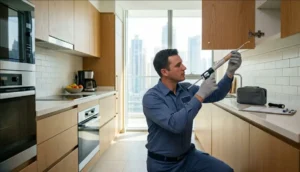
Kitchen work needs a clear distinction between a hidden placement point and a surface that holds food or utensils. Do not assume that a gel can be placed on every cabinet shelf or that a spray can be applied over a worktop simply because it is sold for insects.
For a concrete example, Syngenta’s UAE Advion cockroach gel label excludes locations where food, utensils or food-contact surfaces may be exposed. These are directions for that product, not permission to apply every gel in the same way. Request the actual label for the product in your quotation.
Ask what to remove or cover before the visit and how the team will prevent unwanted contact with treated locations. Mention pet bowls, children’s storage, food preparation routines and sensitive appliances. A useful answer identifies the intended points and precautions instead of saying that the material has no smell.
Do not combine products without a coordinated plan
Tell the provider which aerosols, cleaners or other pesticides have already been used and where. Bait placement and other applications must be compatible with the product instructions. Adding a spray over a bait because you want faster results is not a sound way to assess either method.
Ask the company to explain any combined programme by location and purpose. For example, it should distinguish what is being done inside a cabinet area from work at another identified source. “We use both” is not enough information if nobody can say where each belongs or what the resident should avoid doing afterwards.

A clean kitchen still needs source assessment
Remove accessible crumbs, spills and grease, and correct leaks or damaged fittings through the responsible maintenance team. Keep evidence of recurring activity by location. Avoid blaming housekeeping alone when the same insects are repeatedly found at a service opening or another point requiring inspection.
In an apartment, tell building management about relevant shared-area observations. A treatment confined to your kitchen cannot document or repair an area the provider has not assessed. In a food business, coordinate work with the responsible manager and the site’s food-handling arrangements rather than applying a household routine to a commercial kitchen.
Agree the cleaning and monitoring handover
Ask which surfaces can be cleaned, which placements must remain undisturbed and when an area may be used again. Follow instructions for the actual treatment. There is no universal “do not clean for two weeks” rule that can safely replace a product-specific and site-specific handover.
| After the visit | Keep a record of | Ask the provider |
|---|---|---|
| New sightings | Date, exact place and photograph | Does this need reassessment? |
| Monitoring points | Position and observations | Should the point stay in the same place? |
| Cleaning | What was cleaned and when | Could it have affected a treatment point? |
| Repairs | Leak or opening and completion date | Has the source or access route changed? |
Judge progress through the agreed observations and follow-up, not only the number of dead insects seen immediately after treatment. If activity persists, report it rather than repeatedly increasing the amount of product. The EPA’s pest-control precautions reinforce using products as directed and avoiding the assumption that more pesticide is better.
Compare the service, not the method label
Ask quotations to include inspection, the areas involved, method, instructions, monitoring and callback terms. An inexpensive spray-only visit and a bait programme with follow-up are not equivalent scopes. Equally, a higher price does not establish that the plan is appropriate.
Read our questions before hiring and contact GRMC with photographs, the locations of activity and previous product details. Request an assessment and a written plan rather than a guarantee based only on choosing gel or spray.
Frequently asked questions
Is gel always better than spray?
No method name settles the decision for every pest and location. The insect, source, placement and product directions matter. Ask the provider to explain why its proposal suits the evidence in your kitchen.
Is cockroach gel harmless to children or pets?
Do not treat any insecticidal bait as harmless. Placement and access precautions must follow its label and the service instructions. Tell the company about children and pets before the visit.
Can I spray on top of the bait?
Do not add another product without checking compatibility and the instructions with the provider. Tell them what has already been applied. A coordinated plan is easier to evaluate than overlapping DIY treatments.
Should gel be put on food-preparation surfaces?
Follow the actual product label and its exclusions. The UAE label example discussed here excludes exposure of food, utensils and food-contact surfaces. Ask the technician to show the intended placement points before application.
How quickly should I see results?
Ask for the expected observation and follow-up schedule for the proposed method. Speed depends on the infestation and implementation. A fixed promise based on the word gel or spray is not a property assessment.
What if cockroaches return after cleaning?
Report where they were seen and what was cleaned. The provider may need to review placement, the source, repairs or the wider building context. Do not respond by applying a larger amount of product.