Table of Contents
Bed bug treatment in Dubai is normally two visits, not one. The first visit treats the harbourages around where you sleep. The second, usually ten to fourteen days later, is timed to meet the insects hatching from eggs that were already laid when the technician arrived, because eggs survive a great deal of what kills adults.
A single visit can be enough for a very early problem caught in one room. For anything past that, a company quoting one visit has misjudged the job, and a promise that you will never see another bed bug is a marketing line with no biology behind it.
This page explains why that is, where heat treatment falls short, which preparation helps and which preparation actively spreads the infestation, and what we cannot tell you because nobody in this market publishes it.
At GRMC Pest Control, we treat bed bugs in apartments, villas, hotel rooms, holiday homes and staff accommodation across Dubai and Abu Dhabi. We would like you to book us knowing how the job actually behaves, which is why our bed bug work is quoted as two visits from the start.
One correction before anything else. An older article on this site called heat treatment a one-and-done solution, while another page on the same site required a Day 14 follow-up. Those two statements cannot both be right. The section below settles it, and the older wording is being removed.
What bed bug treatment in Dubai and Abu Dhabi actually involves
Before the detail, the shape of the job.
- An inspection first: the whole room gets checked, including behind the headboard and inside the bedside units. A price quoted over the phone, before anyone has seen the room, is guesswork.
- Treatment aimed at the harbourages: products go into seams, joints, drawer runners and skirting gaps. Spraying open floor and mattress tops looks thorough and achieves very little.
- A scheduled recheck: ten to fourteen days later for anything beyond a very early case. It is planned into the job from the start, for the biological reasons set out below.
- Your preparation: what you launder, what access you arrange and what you leave alone. What you do between the booking and the visit changes the result as much as the products do.
- A written report: what was found, where, what was applied and what is scheduled. If you are a tenant, a landlord or a holiday home host, this document is the part you will actually need later.
Why the eggs are the reason one visit rarely finishes the job
The eggs are the part of a bed bug problem that sets the schedule, so they are worth understanding before anything else.
Why the eggs survive what kills the adults
A bed bug egg stays where the female left it. The University of Kentucky’s entomology extension describes the eggs as tiny, whitish and hard to see without magnification, laid in secluded places, and sticky when first laid, so they hold fast to the surface they land on. An egg does not walk across a treated surface, it does not groom itself, and it does not breathe the way an adult does. That is why a residual product worked into a harbourage can perform well against everything crawling and still leave a viable clutch behind it.
The same Kentucky fact sheet puts the timing plainly: “At room temperature, bed bug eggs hatch in about a week”, and adult females deposit “one, two or more per day, potentially hundreds during their lifetime”. The eggs sitting in your bed frame on treatment day are on their own schedule, and that schedule started before we did.
The United States Environmental Protection Agency reaches the same conclusion from the householder’s side. Its do-it-yourself guidance tells readers to “continue to inspect for bed bugs … at least every 7 days in case any eggs remain”, and warns that the steps may have to be repeated to deal with the bugs and their eggs. Nobody serious treats this as a one-pass problem.
What the follow-up interval is actually keyed to
The recheck interval is set by the insect’s development. That window has a floor and a ceiling, and ten to fourteen days sits between them.
The floor is egg hatch. Come back too early and the eggs laid before treatment have not opened yet, so you are treating a room that has not finished revealing itself and you will be back again. About a week at normal room temperature, per the Kentucky figure above, is the earliest point at which the hatch has happened.
The ceiling is sexual maturity. A hatchling has to feed and moult its way upward before it can lay anything of its own. Kentucky again: the nymphs shed their skin “five times before reaching maturity”, and in favourable conditions of 70 to 80 degrees Fahrenheit “the bugs can mature in as little as a month”. Come back after that and the generation you were chasing has started another one.
Ten to fourteen days sits inside that window with room on both sides. That is the whole reasoning, and it is why the second visit goes in the diary at the time of booking, with no upsell attached to it afterwards.
Why an air-conditioned flat makes the timing predictable, and the problem year-round
Both of those Kentucky figures hang on temperature, and this is where the UAE parts company with the markets most bed bug advice is written for.
The favourable band Kentucky names, 70 to 80 degrees Fahrenheit, is roughly 21 to 27 degrees Celsius. That is ordinary comfortable room temperature, which is what air conditioning is set to hold, and a UAE home runs its air conditioning in January as well as in August. Advice written for a temperate country often leans on winter knocking a population back. There is no indoor winter here, so nothing in the calendar slows the development clock down for you.
It also has a consequence for empty property. The United States Centers for Disease Control and Prevention notes that bed bugs “can live several months without a blood meal”, and the EPA’s advice for items that cannot be treated is to seal them in a bag or container and leave them “for up to a year”. A unit that sat vacant between tenancies over the summer has not cleared itself, which is the most common surprise in move-in and end of tenancy work.
Heat and chemical treatment, compared properly
Heat and residual chemical treatment both work. They fail in different ways, and those failure modes are what this section covers.
What heat genuinely does
Heat’s advantage is that it reaches every life stage at once, eggs included, and it leaves no residue in a bed you are going to sleep in that night. The temperatures involved are not extreme. In laboratory work by Roberto Pereira and colleagues at the University of Florida, published in the Journal of Economic Entomology, adults exposed to 45C died at a rate of 83 percent within three and a half minutes, all of them died at 47C within two and a half minutes, and one minute at 49C killed every insect tested. At 39C, four hours produced no deaths at all. Only a few degrees separate an exposure that killed nothing from one that killed everything tested, which is why the temperature in a heat job has to be measured with probes throughout.
Eggs need a little more. The same paper notes that the reported difference in lethal temperature between eggs and adults is small, on the order of a degree, but that for a fixed exposure temperature the time needed for the tougher life stages rises by roughly 80 percent for each additional degree required. In practice that is an argument for holding the target temperature for the full time it takes, which is slower than the quick blast some quotes imply.
Where heat falls short, including in this climate specifically
The first limit is that heat does not spread evenly. Those Florida trials tented the furniture under a plastic enclosure, and the paper records that the room air itself never went above 32C. Even inside a single enclosure, the gap between the coolest and the hottest maximum temperature recorded ranged from more than 4C to nearly 23C. The hottest readings were always at exposed spots in the moving air. The coldest were inside drawers and other insulated locations, especially where something was wrapped in a blanket. Those cold pockets are precisely where bed bugs choose to sit.
The limit that lands hardest in this market is the floor. In that study, treatments in rooms with carpeted floors reached lethal temperature in 2.4 to 3.1 hours. Rooms with tile floors needed 4.9 to 7.3 hours, and the only two trials in which any bed bugs survived were both in tile-floored rooms. In one of those two the treatment never produced a lethal temperature at any monitored point at all. UAE bedrooms are tile, marble or porcelain laid over a concrete slab. Nobody in Dubai has wall-to-wall carpet under the bed. Thermal work here has the floor working against it, which is a concrete reason to be wary of anyone quoting a quick in-and-out heat job.
There is also the question of what happens at temperatures that are hot but not hot enough. Work by Rukke and colleagues in PLOS ONE found that 34C on its own had no observable effect on survival, while 38.5C and 40C killed all exposed bugs within nine days and two days respectively. On the question of insects fleeing a heated room, those authors are careful and so are we: they record that reports of bed bugs dispersing to other rooms because of raised temperatures are anecdotal, and that the temperatures which trigger avoidance “have not been thoroughly investigated”. We are not going to state as fact something the people who study it call an open question.
The limit that gets ignored most often is the simplest one: heat leaves nothing behind. As the Kentucky extension puts it, heat treatment alone “has no lasting (residual) effect should bed bugs be reintroduced into the dwelling”. The moment the room cools it is as open as it was the week before. In a building where the flat next door is untreated, or a home where the same suitcase is about to come back from the same trip, that matters more than the kill rate on the day.
What residual chemical treatment does and does not do
Residual products behave the opposite way. They are weaker on eggs and they keep working for longer. Worked into the harbourages where the insects sit, the residue keeps acting on anything that emerges over the following days, which is exactly what you want when a hatch is coming.
What they will not do is reach the middle of a dense mattress or a stuffed sofa arm, and they will not reliably kill an egg glued into a joint. That is the trade: heat covers the volume it actually reaches, and a residual product covers the days that follow, when whatever survived starts to emerge.
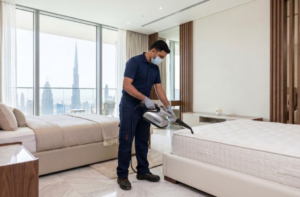
This is why a lot of bed bug work in this market combines the two, with steam or heat applied where the concentration is worst and residual treatment worked through the surrounding harbourages, followed by a scheduled recheck. Which methods your own job needs is a decision for the inspection, and any operator should tell you plainly when a case is early enough to be handled in one visit with a careful recheck.
So, is heat one-and-done?
No, and this site should not have said otherwise. A well-executed heat treatment can clear every life stage in a single session inside the volume that actually reached temperature, which is a narrower statement than clearing a room. The gap between the two is where jobs go wrong.
A recheck belongs in the diary for a heat job too. On a chemical job it is there because of the eggs. On a heat job it is there to confirm that the insulated spots got hot enough, the drawer interiors and the wall gap behind the headboard included, and that nothing has walked back in from a neighbouring unit. One position for the whole site: a second visit is normal, and it belongs in the schedule from the start.
Preparation that helps, and preparation that makes it worse
Preparation is the one part of this that is entirely in your hands, and it is also where well-meaning people do the most damage in the days before a visit.
What genuinely helps
- Launder, and then tumble dry: wash bedding and affected clothing on the hottest cycle the fabric allows, then dry it on high heat. The EPA’s guidance puts the dryer at the centre of home treatment, and the Florida temperature data explains why: a hot dryer clears the lethal band comfortably, a warm wash may not.
- Bag the clean laundry and keep it sealed: sealed until both the treatment and the recheck are done. Putting clean clothes straight back into an untreated wardrobe undoes the laundry.
- Empty the bedside drawers: the runners and the joints behind them are a standard harbourage and cannot be treated through a full drawer.
- Pull the bed and bedside units off the wall: a few centimetres of access is the difference between treating the headboard mounts and looking at them.
- Vacuum, then dispose of the bag outside the property: the EPA is specific here, saying to seal the bag as tightly as possible and immediately throw it out in an outdoor bin. The kitchen bin and the chute room on your own floor are both worth avoiding.
- Sort out access before the day: in most Dubai and Abu Dhabi towers and gated communities that means a gate pass, a note to building management, or a service lift booking. A technician held at a security desk is an hour of your treatment window gone.
What actively makes it worse
The most damaging thing we see is the full-flat tidy-up. Someone finds bed bugs on Thursday, spends the weekend bagging everything in the bedroom, and carries those bags through the living room to the spare room, the maid’s room and the hall cupboard. Bed bugs drop off bags in transit. The Kentucky extension makes the point in the context of discarding infested items: bagging or wrapping in plastic before anything moves is what “prevents dislodgement of bed bugs en route”. Move first and bag later and you have seeded three new rooms in one afternoon.
Moving where you sleep does much the same damage. It feels like the obvious defensive move and it achieves the opposite. The CDC notes that bed bugs “can travel over 100 feet in a night but tend to live within 8 feet of where people sleep”. The population follows the sleeper. Move to the sofa and, over the next fortnight, the infestation follows you to the sofa, and now there are two treatment zones instead of one.
Retail insecticide comes next, and particularly the total-release foggers sold as bug bombs. Repellent products applied across open surfaces push a population deeper into wall voids, skirting gaps and furniture cavities where a technician then has to chase it, and they turn a problem concentrated in one bed frame into one distributed across a room. The EPA’s own warning goes past efficacy, telling readers to use foggers “only with extreme care” because “improper use can harm your health or cause a fire or explosion”.
Throwing out the mattress on day one is another. A treated mattress is usually salvageable, a discarded one has to travel down a corridor and into a lift, and an unwrapped one seeds every metre of that route. Kentucky’s position is that most belongings need not be discarded, though occasionally it is advisable. If something genuinely has to go, wrap it before it leaves the room and mark it so nobody takes it home.
The last one is saying nothing to anyone. If you live in a tower, the flat next door is part of your problem, and a resident who tells nobody is a resident who gets re-infested after a clean treatment. More on that below. For the measures you can reasonably take yourself before we arrive, our guide to how to get rid of bed bugs covers the home side in more detail.
How bed bugs arrive in Dubai apartments and hotels
A bed bug problem has very little to do with how clean a home is. The insects arrive because something they were already living in was carried in.
The routes in
The CDC describes the mechanism without embellishment: they spread by getting “into the seams and folds of luggage, overnight bags, folded clothes, bedding, furniture, and anywhere else they can hide”. In a city where a large share of residents fly several times a year and a large share of flats are let furnished or short-term, that mechanism gets a great deal of practice.
The routes we see most often in Dubai and Abu Dhabi are a suitcase back from a trip, a second-hand or handed-down bed frame or sofa, a furnished flat that arrived with its previous tenant’s problem, a guest’s luggage in a short-let, and an adjoining unit in the same building. The used item is the one people never suspect, because it looks clean and the insects are down inside the joint where nobody checks.
If you travel regularly, the cheapest control you will ever run is a check of the room before you unpack. Our seven-minute hotel room inspection checklist for Dubai sets it out step by step, along with what to do at the front desk if you find something, and it covers holiday home stays as well as hotels.
Towers, and the neighbouring unit problem
In a tower, a flat is not a sealed box. Skirting voids and the gaps around service risers and pipework give an insect a route between units, and a cleared flat next to an untreated one is a flat waiting to be re-infested. This is the most common reason a resident tells us the treatment did not work, when in fact it worked and the source was never in their flat.
What to do about it is practical. Tell building management or the owners association in writing, and ask them to arrange inspection of the units either side, above and below yours. Building managers here generally take this seriously, because a bed bug problem that spreads along a floor becomes their problem and their cost. Send the treatment report with the request, because a written record gets acted on more often than a phone call does.
If a neighbour refuses access, you are on a slower path. In that situation we treat and monitor your unit on a tighter schedule and pay particular attention to the shared wall, the skirting on that side, and any service penetration through it. That is containment while the source stays untreated, and we will say as much on the day.
Hotels, holiday homes and staff accommodation
Hotels and licensed holiday homes have the same biology and a different clock. The room is revenue, turnover is fast, and documentation matters because a guest complaint or a booking platform dispute will ask what was done and when. For these clients the deliverable is as much the report and the schedule as the treatment itself.
Staff and labour accommodation is its own case. Shared sleeping rooms, bunk frames with many joints, and personal belongings stored under beds mean one untreated room seeds the block, so the work has to be scheduled across the whole block. Treating a single room in a fifty-bed building and calling it finished is how the same building calls back six weeks later.
The specific inspection points on a bed
If you want to check before calling anyone, check these, in this order, with a torch and something thin like a bank card to run along seams. You are looking for live insects, pale shed skins, dark ink-like spotting that smears when wiped with a damp cloth, and tiny pale eggs cemented into a crack.
- Mattress piping, all four corners: the corded seam running around the edge, on the top and the underside, plus the care label and any stitched-on tag, which is a favourite gap.
- The base or divan underside: lift the mattress and check the top edge of the base and every point where mattress and base touch. On a divan, check the stapled fabric dust cover underneath.
- Frame joints, bolt holes and slat ends: corner brackets, screw and bolt recesses, and the end of each slat where it sits in the side rail. Wooden frames hold more than metal ones.
- The headboard, front and back: buttoning and panel seams on the front, then unhook it if you can and check the rear panel and the wall mounts. In hotels and serviced apartments the wall-mounted headboard is the classic harbourage.
- The wall gap behind the headboard: including the skirting behind the bed and any socket or switch plate on that wall.
- Bedside tables: pull the drawers fully out and check the runners, the underside of the drawer base and the inside back of the carcass.
- Upholstered furniture near the bed: cushion seams, zip lines and the underside of the frame. The CDC’s eight feet from where people sleep is a sensible radius to work to.
- Curtain hems and the skirting edge: where a floor-length curtain touches the tile, and the joint between skirting and floor along the bed wall.
One thing not on that list is your skin. Bites are a prompt to look, not a diagnosis. People react very differently and some do not react at all, so a bite pattern is a reason to run the checks above and never a confirmation on its own.
Approvals: what Dubai Municipality issues, and who regulates Abu Dhabi
This is the corner of the market with the most badges and the least checkable information, so here is what is actually true.
Dubai
Pest control companies in Dubai are handled by Dubai Municipality’s Public Health Pest Control Section, which issues a No Objection Certificate to a pest control company before it obtains its trade licence, regulates and qualifies those companies, and publishes a list of approved companies that anyone can look at. That list is the check worth running before you book anybody, us included, and it is more useful than any badge printed on a website.
Two things that list does not mean. There is no public per-company licence number in this system, so anyone quoting you one should be asked what exactly it refers to. And the A, B and C classification is a band based on company size. It reflects how many people a company employs, and it says nothing about how well any of them treats a bedroom, so a letter quoted on a website is not the quality signal it looks like.
Bed bug work sits within general pest control, which is what the Group listings cover. Fumigation, termite work and bird control are treated as separate specialist categories, so a general listing is not a claim about any of those.
Abu Dhabi
Abu Dhabi is a different regulator, and a lot of published advice about it is out of date. Work permits for public health pest control activities are issued by the Abu Dhabi Public Health Centre. Its own page states that public health pest control services have been transferred under the Centre’s mandate, that the Centre issues and renews work permits for all public health pest control activities, and that applications go through the TAMM platform. ADPHC puts no date on that transfer, so neither do we. What matters when you are booking is the current position: in Abu Dhabi the document to ask for is an ADPHC work permit, whatever other approvals a company shows you.
One further thing matters more for you than for us. Abu Dhabi does not publish a searchable public list of permitted pest control companies the way Dubai does, so for an Abu Dhabi job you cannot look a company up yourself. Ask to see the permit documentation directly. And note what follows from that: a Dubai Municipality approval is a Dubai credential and says nothing about standing in Abu Dhabi. We go through how to assess a company in an emirate with no public register in our guide to pest control companies in Abu Dhabi.
What changes the price, and what is not on this page
The variables are the same for every company quoting you, so it is worth knowing which ones actually move a number.
- How many rooms are involved: the number of affected rooms moves the price more than the property’s floor area does. A four-bedroom villa with activity in one bedroom is a smaller job than a two-bedroom flat with activity in both bedrooms and the majlis.
- How far it has spread from the bed: a frame-and-mattress problem is a different job from one that has reached the sofa, the curtains and the skirting.
- Volume of upholstered furniture: every fabric item within range of the bed is another set of seams to work through.
- Method: targeted residual work, steam and thermal work are priced differently by every company that offers them, and thermal work on a tiled floor takes longer than the same job elsewhere.
- Whether neighbouring units are in scope: in a tower this is often the difference between a fix and a cycle.
- Access and preparation state: a room prepared as described above treats faster than one that has to be dismantled on arrival.
There is no bed bug price on this page. A headline figure for bed bug work is set before anyone has seen the property, which means it is either an entry price that will change or a number with nothing behind it, and neither helps you compare quotes. What we do instead is quote after the inspection, in writing, with the recheck already inside the figure, so it cannot be added to your bill later. For the wider picture of what pest control work costs here and how it is regulated, see our Dubai pest control costs and laws guide.
What we cannot tell you
A page like this is usually where a pest control company promises the problem will never come back. We are not going to, for a reason that has nothing to do with confidence in our technicians.
Bed bugs arrive from outside. They come in on a suitcase, on a delivered sofa, on a guest, or through a wall from a flat we were never asked to treat. No treatment, ours or anyone else’s, changes what walks back through your front door next month. A company that says otherwise is either not thinking about it or is counting on you not to.
There are also things about this market we cannot verify and will not pretend to. Abu Dhabi publishes no register to check any company against, ours included. Star ratings and review counts on pest control websites in the UAE are almost never independently checkable, which is why you will not find any on this page. And where the science is unsettled, such as whether and at what temperature bed bugs flee a heated room, we have said so plainly above.
What we do commit to is a written scope before we start, a stated recheck date, a report of what was found and what was applied, and a straight answer when the answer is that your neighbour’s flat is the problem. Our bed bug treatment also carries a money-back promise tied to exactly that two-visit logic: if bed bugs are still there after the second visit, you get your money back. Contact GRMC Pest Control to arrange a bed bug inspection in Dubai or Abu Dhabi, and tell us on the call whether you are in an apartment building so we can advise on the neighbouring units before the visit.