Termite season in the UAE is the short spell each year when colonies release their winged swarmers, and the local evidence places it at the start of spring, on humid days and at night. The national termite survey, carried out by a UAE University entomologist across all seven emirates between March 2000 and May 2002, collected winged termites only in spring, at swarming time. The colonies themselves keep feeding outside the swarm season, mostly out of sight, which is why a swarm is so often the first sign anyone notices.
Rain moves the date around. The University of Kentucky’s entomology extension describes swarms as “triggered by warmer temperatures and rainfall”, and rain in this country is scarce and irregular. A humid spell in spring, or the evening after a shower, is the moment to look at your window sills and the ground under your outdoor lights.
Timing is only part of what people want to know when they find wings on the floor. The rest is who should deal with it, and in Dubai the answer is narrower than most homeowners expect, because termite control has its own approval, separate from general pest control.
At GRMC Pest Control, we are on Dubai Municipality’s approved list for general pest control and we are not on its separate termite control list. So this guide is written to help you work out what you have found and choose the right contractor for it, which is the most useful thing we can offer on a termite problem in Dubai.
It covers termite season in the UAE using the country’s own survey data: when swarms happen, which six species the national survey recorded, how to tell a swarmer from a flying ant, the signs that point to your own villa, who regulates termite work in each emirate, and what to ask a contractor before you sign anything.
Termite season in the UAE at a glance
The short version first, with the evidence behind each point further down.
- Spring is the swarm window: the UAE survey collected winged adults after swarms “during a humid day or at night at the beginning of the spring”, and found winged termites in no other season.
- Humidity and rain set the exact date: swarms follow warm, humid weather and rainfall, and UAE rain is too irregular to pin to a particular month.
- Summer hides colonies without stopping them: the survey describes UAE termites either foraging at night or travelling inside soil tunnels that shield them from the heat and sun.
- Every species in the national survey lives in the ground: all six species it recorded were subterranean and reached wood through tunnels in the soil.
- Swarmers indoors are the serious sign: winged termites emerging inside a home almost always mean an infestation, while a swarm from an old palm stump at the far end of the garden does not automatically involve the house.
- In Dubai, termite work has its own list: Dubai Municipality lists termite control companies separately from general pest control, and its August 2026 edition names 163 of them.
When do termites swarm in the UAE?
A swarm is how a termite colony spreads. The Kentucky extension sets out the sequence: once warmth and rain trigger the flight, the winged termites leave the colony, then “drop to the ground, shed their wings, pair off with a mate, and attempt to begin new colonies in the soil”.
The same guidance adds that swarmers emerging inside a home “are incapable of damaging wood and only live for about a day”. You can sweep or vacuum up the insects themselves and then turn to where they came from, which the rest of this guide helps you work out.
What the UAE’s own survey recorded
Most published advice on swarm timing is written for the United States. The only national termite survey of the UAE we have found is the one by W. Kaakeh of UAE University’s Department of Arid Land Agriculture, published in 2005 in the Journal of Agricultural and Marine Sciences. It covered 64 field trips and 224 inspected sites across all seven emirates, 115 of them in Abu Dhabi and 46 in Dubai.
Two lines in its methods section are the closest thing to a local swarm calendar we have found. Winged adults of most species were collected after their swarming periods, “during a humid day or at night at the beginning of the spring”, and “soldiers and winged castes were only collected during the spring season at the time of termite swarming”.
The survey also found that workers of most species “forage in the open from late afternoon to early morning”. That is worth remembering if you only ever look around the garden in the middle of the day.
Why this page gives no month-by-month calendar
Several pest control websites in Dubai publish confident swarm months. None of the ones we read cites a study for them, and we have not found a published month-by-month record of termite flights in the UAE. What the evidence supports is spring swarming on humid days and nights, with rain as a trigger.
Rain is also where the UAE differs most from the countries that write the textbooks. The Kaakeh survey describes annual rainfall here as “highly variable” and notes that Abu Dhabi and Dubai usually record less than 100 mm a year. A dry spring may pass with little to see, while a humid spell after rain is when flights are most likely. The first warm, humid nights of spring, and the evenings after any rain, are the times to check sills, window tracks and the paving under outdoor lights.
What happens in summer
Surface signs thin out in the heat, and that is easy to read as the problem going away. The survey describes two ways UAE termites cope with the climate: species either forage at night, or build protective soil tunnels “within which they are shielded from heat and desiccating effects of the sun”.
The survey also opens by noting that termites have become increasingly important pests of crops and buildings in the UAE where desert land is irrigated. A villa garden watered every day is a small version of the same thing, with moist soil against the building right through the hottest months.
The six termite species in the UAE’s national survey
The Kaakeh survey identified six species from five genera and three families, and it reported five of them as new records for the country. The sixth, Heterotermes aethiopicus, was already known from a single earlier record of a colony infesting a house in Al Ain. All six were found in both Abu Dhabi and Dubai.
The dominant species overall was the harvester termite Anacanthotermes ochraceus, followed by the sand termite Psammotermes hybostoma and Microcerotermes diversus. Dubai reads differently from the national picture. In the survey’s own table, the sand termite turned up at 43.5 percent of the 46 Dubai sites inspected against 28.3 percent for the harvester termite, while in Abu Dhabi the order ran the other way, at 30.4 and 39.1 percent of 115 sites.
Harvester termites (Anacanthotermes ochraceus and Anacanthotermes ubachi)
These are the termites most often seen above ground. The survey collected A. ochraceus from the soil surface among dry grass and plant debris, the feeding habit that gives the group its common name.
They reach buildings too. The survey found A. ochraceus and the sand termite “attacking and destroying roofs of historical buildings and causing damage to constructional timbers and furniture”, and in rural homes in Dubai and Abu Dhabi the two species had removed the straw from the mud bricks.
The sand termite (Psammotermes hybostoma)
The survey spells it hypostoma; both spellings appear in the literature for the same insect. It favours sandy, lightly planted ground where water drains fast and where, in the survey’s words, it would be possible to construct tunnels to a water table that “may be at a depth of 10 m”.
It tends to replace the harvester termite in hot, sandy terrain, and the survey records it attacking roofs of historical buildings and residences in Abu Dhabi and Dubai. On a Dubai plot built on sand, it is a reminder that the colony can sit far below any surface you can see.
The smaller species
Microcerotermes diversus was the third most common species overall and was found in live date palms in Abu Dhabi and Sharjah. Heterotermes aethiopicus is the species behind the earlier record the survey cites, the house in Al Ain. Microtermes najdensis is the one species the survey did not record in buildings.
More broadly, the survey reports that damage to wood in residences and historical buildings “was inflicted by all identified species in all emirates”, with M. najdensis the only exception.
Date palms, store rooms and furniture
Date palms were affected by every species at some level. The most common form of attack was “the hollowing-out of the palm roots, which may be followed by yellowing and death of palm trees, especially young trees and offshoots”.
Stored wood and furniture were affected by all six species in all emirates, paper by several of them, and in Abu Dhabi non-cellulose items such as carpets, leather and rubber were affected too. A store room with cardboard boxes sitting on the floor belongs in the same picture.
What the survey did not find
Many pest control pages in Dubai name the Asian subterranean termite, Coptotermes gestroi, as the main threat to villas. It is not among the six species the national survey recorded. A 2021 checklist of Arabian Peninsula termites (Sharaf et al., Saudi Journal of Biological Sciences) does list a Coptotermes species, C. heimi, from the UAE and notes that some taxonomists treat it as C. gestroi, but no UAE study we found identifies it as the main threat to villas.
The survey also recorded no drywood termites, the kind that live entirely inside dry timber. Every species it found nests in the soil and reaches wood from the ground, and the control measures the survey names for damaged homes in Abu Dhabi and Dubai are chemical preservatives, pressure injection, barrier treatments and baits.
Flying termites or flying ants: a quick check
According to the Kentucky extension, ants tend to swarm at the same time of year as termites, so timing alone will not tell you which you have. Look at a dead one under good light and check these features.
- Antennae: a termite’s are straight, though the US Environmental Protection Agency notes they may droop. An ant’s are bent at an elbow, close to a right angle.
- Waist: a termite has what Kentucky calls “a uniformly thickened waist”. An ant is pinched in sharply between the thorax and the abdomen.
- Wings: a termite carries two pairs of roughly equal length. On an ant, the front wings are longer than the hind wings.
- What is left behind: termites shed their wings after landing, so loose wings of matching size gathered on a sill or in a window track point to termites.
If the insects on your sill turn out to be flying ants, you are dealing with a general pest, and our ant control service covers that, including tracing the colony back to where it nests.
Signs the colony has reached your villa
A swarm tells you a colony is nearby. These signs, most of them from the Kentucky extension’s guidance for homeowners, tell you whether it is in the building.
- Swarmers indoors: Kentucky’s guidance is that “discovering winged termites indoors almost always indicates an infestation warranting treatment”. Swarmers are drawn to light, so look around windows, balcony doors and the light over the kitchen or service door.
- Swarmers at the building line: a swarm from a dead palm stump or a pile of old timber out in the garden does not automatically mean the house is infested. Swarmers emerging next to the foundation or from an adjoining patio mean there is “a good chance the home is infested as well”. In a villa, that means along the plinth and the paved apron around it.
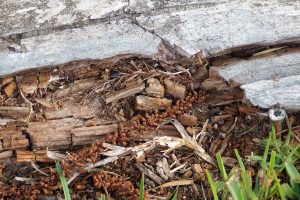
- Mud tubes: earthen tubes “typically about the diameter of a pencil” running up the plinth, a garden wall or the wall behind the AC units. Break a small section open: small, creamy-white workers inside mean the tube is in use. An empty tube does not prove the colony has gone, because termites abandon sections while foraging elsewhere.
- Hollowed wood: termite-damaged wood is hollowed out along the grain with bits of dried mud or soil lining the galleries, which ordinary water damage does not produce. The surface often stays intact, so the EPA suggests probing exposed wood with a flathead screwdriver to find hollow spots in skirting, door frames and built-in wardrobes.
- Pinholes in plaster or board: termites occasionally bore tiny holes through gypsum board or plaster, with bits of soil around the edge, so check gypsum partitions and ceilings close to the ground floor.
- A struggling date palm: yellowing fronds on a young palm or an offshoot, which the UAE survey links to termites hollowing out the roots.
Termites are hard to find even for professionals. Kentucky’s guidance notes that infestations “can go undetected for years” and that “even the most experienced inspector can overlook signs that are hidden”. Any one of the signs above justifies a proper inspection.
What makes a UAE villa attractive to termites
The UAE survey links the rise of termites as pests here to the irrigation of desert land, and notes that the country imports many kinds of wood and wood products for construction and furniture. A villa plot brings both together. The EPA’s prevention advice translates into these local checks.
- Water against the walls: the EPA’s advice is to “keep the soil around the foundation dry through proper grading and drainage” and to fix leaks immediately. On a villa plot, that means drip lines, sprinkler spray and AC condensate outlets that keep the soil beside the plinth damp.
- Planting pressed against the building: the EPA advises that trees and shrubs should not be planted too close to the structure or allowed to grow against exposed wood.
- Timber and cardboard on the ground: the EPA says not to pile or store wood or wood debris next to the house. Pallets, spare decking boards and flattened boxes stacked against a boundary wall are the local version.
- Gaps where services come in: the EPA recommends filling cracks in foundations and around the points where utilities pass through the wall. AC pipework, drainage and cable entries at ground level are the ones to look at.
- Wood touching soil: pergola posts, timber decking and garden fencing set straight into the ground give a soil-dwelling insect a direct route in.
Who is allowed to treat termites in Dubai and Abu Dhabi
Dubai and Abu Dhabi handle this differently, and the sections below quote what each regulator publishes.
Dubai: check the termite control list specifically
Pest control companies in Dubai are cleared by Dubai Municipality’s Public Health Pest Control Section, which issues each one a No Objection Certificate and publishes a list of approved companies. There is no public licence number to look up. The published list is the check.
That list is divided by scope. Its general pest control section states that those companies are licensed “for general pest control operations excluding fumigation, termite control and bird control”, and termite control has a separate list further into the same Approved Pest Control Companies document. In Dubai Municipality’s August 2026 edition, the termite list holds 163 companies. For a termite job in a Dubai property, the contractor you book should appear on that list, under the registered company name printed on your quotation.
Our guide to checking Dubai Municipality approval walks through the search step by step, and our guide to choosing a pest control company in Dubai covers what separates two companies that are both on it.
We apply the same check to ourselves. GRMC appears in the August 2026 edition at entry 135, in Group C of the general list, under the registered name G R M C FOR PUBLIC HEALTH PESTS CONTROL SERVICES CO. L.L.C. Dubai Municipality’s list defines Group C as companies with 1 to 10 qualified pest control staff. GRMC does not appear on the termite control list in that edition, so for termite work in a Dubai property, book a company that does.
Abu Dhabi: ADPHC permits, and no public register
Dubai Municipality approval is a Dubai credential and carries no standing in Abu Dhabi. There, the Abu Dhabi Public Health Centre states on its own service page that public health pest control services “have been transferred under our mandate” and that the Centre “will issue and renew work permits for all public health pest control activities”. The same page routes requests through the TAMM platform or the helpline on 800555.
ADPHC publishes no searchable list of permitted companies, so the public list check available in Dubai has no equivalent in Abu Dhabi. Ask the contractor to show you its ADPHC work permit documentation and to confirm in writing that it covers the work being quoted, or put the question to ADPHC directly.
What to ask a termite contractor before you sign
Once you know a company is on the right list, the quotation tells you how it plans to do the work. These are the questions worth asking, and the answers are worth having in writing.
- Which list or permit covers this job, and under what registered name? In Dubai, the answer should be the Municipality’s termite control list. In Abu Dhabi, it should be an ADPHC work permit you can see.
- What exactly did the inspection find? Ask for the locations, the evidence (tubes, damaged wood, live workers, wings) and whether the species was identified. The Kentucky extension recommends inspections and estimates from more than one company, which “will help verify the existence of a termite infestation and allow you to compare services”.
- Liquid barrier, baits, or both, and why? Kentucky describes liquid termiticides as a long-lasting barrier in the soil, and warns that with baits “it may take weeks or months for termites to find the belowground installations and months more to achieve control”. Because a colony forages in many directions, it also calls localised spot treatments “usually a gamble” unless they are a retreatment under an existing service agreement, so ask why the proposed area is the right one.
- Which product, and can I see the label? The EPA’s advice is to ask the company representative for a copy of the product label, and it notes that a product whose label carries no directions for protecting a structure against termites “should not be applied” for that purpose. Ask for the safety data sheet as well.
- When can the family and pets go back in? The EPA says re-entry time varies by product and appears on the label, and advises making sure the applicator has told you when you are allowed to re-enter.
- How will you drill, and how will you make good? Liquid treatments usually mean drilling through paving or floors along the building. Ask how holes in marble, porcelain or interlock paving will be sealed, what happens to irrigation lines and planting beds, and whether you will get photographs of the finished work.
- What happens if activity comes back? Kentucky is candid that “even the best treatments performed by knowledgeable pest control firms may fail at times”, when termites find untreated gaps in the soil. Ask what the written terms say about a return visit, how long they run and what would void them.
- Am I being pushed to sign today? Kentucky’s advice is to take your time: “Termites damage wood slowly”, and it tells homeowners to avoid firms “that try to pressure you into signing a contract immediately with specials or scare tactics”.
If you are buying a new villa, add one more: ask the developer whether the ground was treated for termites before the slab was poured, by which company, with which product, and ask for the paperwork.
Online reviews can add to this if you read them closely. Our guide to reading pest control company reviews in the UAE explains what to look at beyond the star rating, starting with how a company answers its complaints.
What termite work costs, and why a phone quote means little
There is no termite price on this page. We are not on Dubai Municipality’s termite list, so a figure from us would not help you compare quotes, and any termite price given before someone has walked the property is a guess.
What moves a termite quote
The length of building line to be treated, and whether the colony is at one corner or along several walls. The floor finish and paving that have to be drilled and made good. Access around planting, decking and boundary walls. And the method, since a baiting programme involves monitoring visits spread over months, according to the Kentucky timeline above.
The treatment is rarely the whole bill. Skirting, door frames and built-in joinery that a colony has hollowed out have to be replaced on top of it, which is why the cheapest step in this whole guide is checking the sills after the first humid nights of spring.
Your swarming-season checklist
On top of the fixes to water and timber above, three habits are worth keeping each spring, whichever emirate you live in.
- Check the morning after humid nights and rain: window sills, window tracks, balcony thresholds and the paving under outdoor lights, looking for wings of matching size.
- Walk the building line regularly through spring: the plinth, garden walls and the wall behind the AC units, looking for pencil-width mud tubes.
- Keep a record: dated photographs, plus a few wings or insects sealed in a small bag or jar, so a contractor can confirm what you saw even if the swarm is over by the time they arrive.
Frequently asked questions
When is termite season in the UAE?
Termite swarming in the UAE happens mainly at the start of spring, on humid days and at night. The national termite survey by UAE University, carried out between March 2000 and May 2002, collected winged termites only in spring, at swarming time. The colonies do not disappear in summer: the same survey describes UAE termites foraging at night or inside soil tunnels that shield them from the heat.
What triggers a termite swarm?
Warm, humid weather and rain. The University of Kentucky’s entomology extension describes swarms as triggered by warmer temperatures and rainfall, and the UAE survey collected winged termites after swarms on humid days or at night in early spring. UAE rainfall is low and varies widely from year to year, so the first humid nights of spring and the evenings after rain are the times to check.
How can I tell flying termites from flying ants?
According to the University of Kentucky’s entomology extension, termites have straight antennae, a uniformly thickened waist and wings of equal size, while ants have elbowed antennae, a pinched waist and front wings longer than the hind wings. Termites also shed their wings after landing, so loose wings of matching size on a sill or in a window track point to termites.
Which termites are found in Dubai and Abu Dhabi?
A national survey by UAE University, published in 2005, recorded six species, all of them subterranean and all present in both Abu Dhabi and Dubai: Anacanthotermes ochraceus, Anacanthotermes ubachi, Psammotermes hybostoma, Microcerotermes diversus, Heterotermes aethiopicus and Microtermes najdensis. The harvester termite Anacanthotermes ochraceus was the most common overall, while the sand termite was found at the most Dubai sites. The survey recorded no drywood termites.
Does a termite swarm mean my house is infested?
If the swarmers emerge indoors, almost certainly: the University of Kentucky’s entomology extension says winged termites found indoors almost always indicate an infestation warranting treatment. A swarm from a dead palm stump or a pile of old timber out in the garden does not automatically involve the house, but swarmers emerging next to the foundation or from an adjoining patio mean there is a good chance the home is infested as well.
Who is allowed to treat termites in Dubai and Abu Dhabi?
In Dubai, Dubai Municipality lists termite control companies separately from general pest control, and its general list states that those companies are licensed for general pest control excluding fumigation, termite control and bird control. The August 2026 edition of the Municipality’s termite list holds 163 companies. In Abu Dhabi, the Abu Dhabi Public Health Centre (ADPHC) states that it issues and renews work permits for all public health pest control activities, and it publishes no public list, so ask the contractor for its ADPHC permit documentation.
Is termite treatment safe for children and pets?
Ask before treatment day. The US Environmental Protection Agency advises asking the company for a copy of the product label and making sure the applicator tells you when you can re-enter, because re-entry time varies by product. The University of Kentucky’s entomology extension suggests that people who remain apprehensive about liquid treatments may want to consider baits, which sit in stations in the ground.
How much does termite treatment cost in the UAE?
A reliable figure needs an inspection first. The price depends on the length of building line to treat, the floors and paving that have to be drilled and made good, access, and the method, since baiting involves monitoring visits over months. Repairs to hollowed skirting, door frames and joinery come on top of the treatment, so ask for a written quote that names the method, the product and the number of visits, and whether VAT is included.
Found swarmers this week? What to do next
The right next step depends on what you found and where the property is.
- If they are flying ants: this is general pest control. Trace where they are coming in, and call a general pest control company if they keep appearing.
- If they are termites and the property is in Dubai: book a company from Dubai Municipality’s termite control list, and put the questions above to it before you sign.
- If they are termites and the property is in Abu Dhabi: ask to see the contractor’s ADPHC work permit documentation and confirm what it covers.
- If you cannot tell: keep a few specimens and photographs, and get more than one inspection, as the Kentucky extension recommends.
For ants, cockroaches, bed bugs and the rest of general pest control across Dubai and Abu Dhabi, that is our work. Contact GRMC Pest Control to book an inspection, and if what you describe on the call sounds like termites, we will tell you so and point you back to the checks on this page.
Details on this page were checked on 21 September 2026 against the national UAE termite survey (W. Kaakeh, Journal of Agricultural and Marine Sciences, 2005), the 2021 Arabian Peninsula termite checklist (Sharaf et al., Saudi Journal of Biological Sciences), the University of Kentucky’s ENTFACT-604 and the US EPA’s termite guidance, the August 2026 edition of Dubai Municipality’s Approved Pest Control Companies list, and the Abu Dhabi Public Health Centre’s pest control services page. List editions change, so check the current document before you rely on it.