Table of Contents
Chemical vs heat treatment for bed bugs comes down to two different strengths. Heat kills every life stage, eggs included, but only in the spaces that actually reach a lethal temperature, and it leaves nothing behind once the room cools. Residual chemical treatment keeps working in the cracks and joints where bed bugs live for days after the visit, but it is weak against eggs. For most apartments in Dubai and Abu Dhabi the plan that holds uses a residual product as the base, adds heat or steam where the insects are concentrated, and books a follow-up visit from the start, whichever method leads.
An earlier version of this page said something else. It called heat treatment a one-and-done solution and “the undisputed champion”, quoted a lethal temperature without naming any study, and cited a Dubai rental law principle without naming the law it came from. Our main bed bug treatment Dubai guide already said that a second visit is normal, so the site was contradicting itself. This version replaces the old one, and the claims it dropped are listed near the end.
What follows covers what each method does inside a room, where each one fails, which one suits a tower apartment, a villa, a hotel room or a holiday home, and why the follow-up visit exists with both.
At GRMC Pest Control, a family-owned company founded in 1990 with offices in Dubai and Abu Dhabi, we choose the method for a bed bug job at the inspection, once we have seen the room, the furniture and the building around it.
This guide sets out a sourced comparison of chemical vs heat treatment for bed bugs, drawing on university extension guidance, US Environmental Protection Agency material, peer-reviewed heat studies and UAE government warnings, so you can judge a quote before anyone starts work in your home.
Chemical vs heat treatment for bed bugs at a glance
Here is the comparison in brief, with the detail and the sources in the sections that follow.
- Eggs: heat kills them wherever a lethal temperature is reached and held. Residual products act mainly on insects that walk across a treated surface, and an egg cemented into a joint stays where it was laid.
- Protection after the visit: heat leaves none once the room cools. A residual product keeps acting in the treated seams and cracks over the following days, which is when the eggs hatch.
- Reach: heat can get inside a mattress, a sofa and a full drawer if the hot air is circulated and held long enough. Sprays are kept off sleeping surfaces, bedding and clothing, so those need laundering, a hot dryer or heat.
- Typical failure: heat fails in cold spots, on floors that drain heat away, and when it is switched off too early. Chemical treatment fails when the product is one the local population tolerates, or when it never reached the harbourage.
- Time and disruption: the University of Kentucky notes that heat can often clear an infestation in one day. A chemical programme is quicker per visit, but Kentucky’s summary of insecticide work is that follow-ups are usually needed, so it runs over at least two visits, with preparation before each.
- Cost: Kentucky notes that heat may be more costly, because it needs special expertise and equipment.
- Follow-up: needed with both. After chemical work it is timed to the egg hatch. After heat it confirms that the insulated spots were cleared and that nothing has come back in.
What heat treatment does inside a room
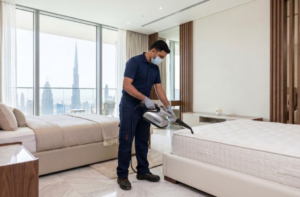
“Heat treatment” covers several different jobs, from a whole flat brought up to temperature to a steamer worked along a mattress seam, and they behave differently.
How a heat treatment works
The whole-room version is described by the University of Kentucky’s entomology extension: portable heaters and fans “gradually heat the air to about 120-130°F while monitoring with strategically placed sensors”, which is roughly 49 to 54°C. Firms use the same approach on single items, single rooms or entire dwellings. A localised version encloses the bed and the furniture around it in an insulated envelope and heats only what is inside.
The temperatures that kill bed bugs are lower than most people expect. In laboratory work by Roberto Pereira and colleagues at the University of Florida, published in the Journal of Economic Entomology, four hours at 39°C killed no adult bed bugs at all, while 47°C killed every one tested within two and a half minutes. The paper did not test eggs. It modelled them as needing about one degree more than adults, based on earlier reports, and estimates that for each extra degree a life stage needs to die, the exposure time at the same temperature rises by around 80 percent. Only a few degrees separate the 39°C and 47°C results, which is why a heat job depends on accurate temperature readings from start to finish.
Steam is the small-scale version, worked seam by seam. The US Environmental Protection Agency says the steam temperature “must be at least 130°F”, about 54°C, and that the steamer should not have a forceful airflow, which can scatter the insects. Kentucky adds that steamers kill bugs and eggs on contact but have “limited ability to penetrate fabric”, which is why steam is used alongside other measures.
What heat does well
Its main strength is the eggs. A lethal temperature held long enough kills eggs, nymphs and adults in the same pass, which a residual product cannot be relied on to do.
It also asks less of you beforehand. Kentucky notes that the de-cluttering needed for heat “is often less than with other approaches”, and that bedding and clothing do not need laundering “since these items will be heated along with other belongings”. Some things still have to come out, and the same fact sheet names aerosol cans, indoor plants and medications. It also records heat’s other advantage: “infestations can often be eliminated in one day, rather than over multiple days or weeks.”
And it leaves no product in the bed you sleep in that night, which matters in a home with a baby in the room or someone who reacts to chemical smells. The earlier version of this page also argued that heat saves you from throwing out an expensive mattress. That point needed correcting, because under either method most furniture can be kept. Kentucky’s guidance is that “most belongings need not be discarded”, and it describes zipped encasements for the mattress and base as “a more economical option” than replacement.
Where heat falls short
Heat jobs that fail tend to fail in one of four places. The first is the cold spot. In the Florida trials the highest temperatures were always at exposed locations in the moving air, and the lowest were inside drawers and other insulated places, especially where something was wrapped in a blanket. One trial shows exactly how that goes wrong. The heat was switched off once the monitored locations reached the target, while a vial of bed bugs wrapped in a blanket inside a chest drawer, far from the heaters and not readable from outside the enclosure, had not yet reached a lethal temperature. Those insects survived. Both heaters had been placed on one side of the enclosure, and the authors concluded that heaters belong at opposite corners, with fans placed to push the heated air around. For anyone buying a heat job, that makes probe placement the first thing to ask about.
The second is the floor. In the same study, rooms with carpeted floors reached lethal temperatures in 2.4 to 3.1 hours, while rooms with tile floors needed 4.9 to 7.3 hours. The two trials in which any bed bugs survived were both in tile-floored rooms. In one of them, a bedroom with vinyl tile over a concrete slab, the temperature in the enclosure levelled off at 41.5°C after 6.3 hours and never reached a lethal level anywhere it was measured, which the authors put down to heat escaping through the plastic cover and the tile floor. UAE bedrooms are tile, marble or porcelain on a concrete slab, so a heat job here should be planned at the long end of those timings, with the heated area properly enclosed. Our main bed bug guide covers this tile penalty in more detail.
The third is movement. Pereira and colleagues note that a fast rise in temperature outside a piece of furniture “would likely cause bed bugs to move further inside the furniture, moving away from rising temperatures”, and they cite an earlier attempt to kill bed bugs in encased mattresses with sunlight that reportedly failed because the insects moved away from the hot areas. Warmth that stops short of lethal does little on its own. In a study from the Norwegian Institute of Public Health published in PLOS ONE, adult bed bugs held at 34°C for up to nine days showed no observable effect. Those authors describe reports of bed bugs fleeing to other rooms under heat as anecdotal, so we do not state it as fact either.
The fourth is what happens afterwards. Kentucky’s fact sheet notes that heat treatment alone “has no lasting (residual) effect should bed bugs be reintroduced into the dwelling”, and for that reason some firms apply insecticides at the same time. The Florida team built their method on the same assumption, describing their heat treatment as “intended to supplement a residual pesticide applied to the baseboard and other potential resting areas for bed bugs”. Kentucky also advises occupants to take as few belongings as possible with them while the heating is done, because anything that leaves the room during treatment misses it and can carry insects back in.
What the UAE sun can and cannot do
Living here, the obvious question is whether the summer sun can do the heating for free. For small items it sometimes can. The EPA lists black plastic bags in a hot, closed car in the sun as a heat option, adding that success “depends on your climate and other factors”. Kentucky gives the method in more detail: wrap the items in plastic and leave them for at least a day somewhere hot and sunny, such as inside a closed vehicle parked in the sun, pack them loosely in black bags, lift them off the ground so the heat gets through, and use a thermometer to confirm at least 120°F, about 49°C, wherever the bugs may be.
A UAE summer meets the climate part of that condition far more easily than Kentucky does, but the other factors still apply. A tightly packed bag has a cool centre, and aerosols, medicines, phones and power banks should stay out of a car left in the sun.
What the sun will not reliably do is treat a mattress on a balcony or a sofa on a villa terrace. That is close to the sunlight attempt the Florida paper cites as a failure, and its authors think heat lost to the ground, poor insulation and poor air circulation were probably to blame. Switching off the air conditioning while you travel does not work either. Kentucky states that efforts to rid dwellings of bed bugs “by raising or lowering the thermostat will be unsuccessful”, and the EPA says trying it with a thermostat or space heater “does not work and is dangerous”. In an empty flat, Kentucky adds, bed bugs “often disperse to nearby units, or reduce their activity until the unit is reoccupied”.
What residual chemical treatment does
Kentucky’s fact sheet notes that insecticides “are also used by most professionals”, formulated as liquids, aerosols and dusts. They remain the backbone of most bed bug programmes, and they fail in their own ways.
How it works
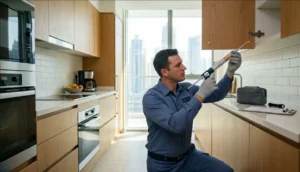
The product goes where the insects live: the seams, folds and crevices of beds, chairs and sofas, bed frame joints and bolt holes, drawer runners, the skirting line and the gaps around fittings on the bed wall. Kentucky notes that companies “usually will not spray the sleep surface or seating area” and do not spray bedding or clothing, which “instead should be hot washed or heated in a dryer”.
The EPA groups the products registered for bed bugs in the United States into classes that kill in different ways: pyrethrins and pyrethroids, desiccants, biochemicals, pyrroles, neonicotinoids and insect growth regulators. That variety matters because of resistance, which comes up below. In the UAE, pesticides are registered through a national system run by the federal environment ministry, so the products on sale here differ from the American list, while the way each class works stays the same.
Desiccant dusts work, in the EPA’s words, “by destroying the waxy, protective outer coating on a bed bug”, and because that action is physical, the EPA says bed bugs cannot become resistant to them. Kentucky rates silica gel dust as potentially “very effective” when applied correctly in tiny amounts, and is far cooler on diatomaceous earth, which it says “will seldom help much to eliminate infestations”. The EPA adds a warning worth repeating to anyone tempted by a bag of pool-grade powder: desiccants intended for other uses, “such as food-grade or for use in swimming pools, pose an increased inhalation risk to people”.
What it does well
A residual product keeps acting after the technician leaves. Nymphs hatching from eggs the treatment missed have to walk out across treated seams and joints, and that stage of the problem is what the residual is there for. It also gives some cover in the days after the visit if bed bugs arrive from the flat next door, which heat cannot offer at all.
It covers ground a localised heat job leaves out. The Florida method heated the furniture inside an enclosure and left the skirting line and the room’s other resting places to the residual product. And it can cost less: Kentucky notes that heat treatments “require special expertise and equipment, and may be more costly than conventional methods relying primarily on insecticides”. In a tower that also means no heaters, fans and cabling to bring up in a booked service lift.
Where it falls short
Resistance is the best-documented weakness. The EPA states that “some bed bug populations have become resistant to pyrethrins and pyrethroids”, and that where resistant strains exist, these treatments “may cause them to move to a new hiding place or temporarily flush them out of existing locations”. Kentucky compares the trend to the way some germs have become resistant to antibiotics. The EPA’s remedy is a combination product, or a switch “to an entirely different chemical class”.
The earlier version of this page claimed that bed bugs in Dubai have developed significant chemical resistance, including thickened cuticles. We have not found published resistance data for bed bug populations in the UAE, so that sentence is gone. The general point stands. If a pyrethroid programme has already failed in your flat, the EPA’s advice points to a different class next time, and you are entitled to ask which class is being used and why.
Eggs are the next problem. An egg sits still in the joint where it was laid, so a product that works on insects crossing a treated surface reaches it poorly, and Kentucky’s summary of insecticide work is that “follow-ups are usually needed”. Some products do list eggs: the EPA notes performance trials showing that the registered neem oil products control “bed bug adults, nymphs, and eggs”. The planning assumption still has to be that some eggs will hatch after the first visit.
Sprays are also kept off sleeping surfaces, bedding and clothing, and they do not get into the core of a dense mattress or a stuffed sofa arm. That is why chemical work comes with a laundry and drying list, and why encasements often join the plan. Kentucky describes zipped encasements as trapping any bed bugs already inside, which “eventually die”, and as making it easier to spot any bugs on the outer surface at later checks.
The chemical that should never be used in a home
The most dangerous chemical used against bed bugs in the UAE is aluminium phosphide, sold illegally as tablets and commonly known as “bomb”. The UAE’s environment ministry, then the Ministry of Environment and Water and now MOCCAE, warned in September 2014 that it turns from solid to gas once the pack is opened, releasing phosphine. Its chemicals director said the substance is banned and “is highly poisonous and could lead to intoxication and fatality”, and the ministry said it was preparing an awareness campaign aimed specifically at residential areas and buildings with centralised air conditioning.
Khaleej Times reported in 2012 that Dubai Municipality’s warning campaigns focused on aluminium phosphide “illegally used for controlling bed bugs”, and that residents were urged not to carry out pest control themselves or use chemicals sold by individuals. In October 2017 an Abu Dhabi pest control official told The National that people were using it “in their flats to fight bed bugs”. If anyone offers to “bomb” or gas your flat, or sells you tablets for bed bugs, refuse, keep the product out of the building and report it.
Retail foggers are a far smaller risk but no better a tool. Kentucky says bug bombs “should NOT be used to control bed bugs”, because they are ineffective “and can result in fires and other dangerous outcomes”, and the EPA notes that the spray “will not reach the cracks and crevices where bed bugs hide”.
What “fumigation” should mean on a UAE quote
“Fumigation” is used loosely here for almost any spray or fog. Real fumigation is something else. Kentucky describes it as a sealed building injected with a lethal gas, usually sulfuryl fluoride, after everyone has left “for a period of days”, and notes that the procedure is “logistically more challenging with multi-unit properties such as apartments”.
In Dubai, fumigation is also a separate regulatory scope. Dubai Municipality’s list of approved pest control companies states that the companies on its general list are licensed “for general pest control operations excluding fumigation, termite control and bird control”, and it publishes a separate fumigation list. Residual, steam and heat work for bed bugs is not fumigation. If a quote for your flat says fumigation, ask exactly what will be used, and if it really is a fumigant, check that the company appears on the fumigation list. For the record, GRMC is on the general list, at entry 135 in Group C of the August 2026 edition, and is not on the fumigation list. Our guide to Dubai Municipality approved pest control explains how to check any company against those lists.
Which method suits which property
The right method depends as much on the building as on the insects.
An apartment in a tower
Kentucky’s extension calls multi-unit housing “one of the most challenging environments for bed bugs”, partly because infested units “often go undetected and/or unreported by tenants”. Its advice is to inspect the units near an infested one, “on either side, above, below, across the hall”. In a tower in Dubai Marina, JLT or on Al Reem Island, the flats around yours may share the problem whether their occupants know it or not.
That is the case for a residual base. A heat-only job in a tower leaves the flat open the moment it cools, next door to units nobody has treated. The plan that tends to hold in a tower apartment is residual treatment through the bedroom and the rooms around it, heat or steam on the worst furniture where the concentration is heavy, and a written note to building management asking for the adjoining units to be inspected.
Heat equipment has to come up in a service lift that usually needs booking, and building management will want notice of contractors and equipment. Sort out access and any gate pass before the day, whichever method you choose.
A villa
A villa means more volume and more rooms, but usually no shared wall. Heat is possible room by room or across the whole house, since Kentucky notes that some firms treat entire dwellings, and the cost climbs with the volume being heated. Villa floors here are usually tile, marble or porcelain on concrete, so the Florida timings apply throughout.
Include the staff quarters in the inspection. A maid’s room or a driver’s room is easy to leave out, and a treatment that skips it can leave a source behind. Bed bugs mostly reach a villa through travel, guests and second-hand furniture, so a targeted plan in the affected bedrooms is often more proportionate than heating the whole house.
A hotel room or serviced apartment
A hotel is the setting where heat’s speed counts for the most. Kentucky notes that heat can often clear an infestation in one day rather than over multiple days or weeks, it leaves no product on the bed, and a room out of inventory costs money every night it stays empty.
The weakness is the same as in a tower: the rooms on either side. The Florida approach, heat on the furniture with a residual along the skirting line, suits a hotel room well, together with inspection of the adjoining rooms and a written record of what was done, since a guest complaint or a booking platform dispute will ask for one. Our hotel room inspection checklist for Dubai covers the guest’s side of the same problem.
Holiday homes and short lets
Guest turnover means new luggage every few days, so reintroduction is constant. Over a season, encasements, a residual at the bed and along the room perimeter, and a quick inspection between guests tend to matter more than any single heat treatment. Kentucky notes that dish- or dome-shaped interceptor traps under bed legs “can help reveal presence of bugs in the important early stages of infestation”, which suits a property that changes hands every few nights.
Staff accommodation
Shared rooms, bunk frames with many joints and belongings stored under beds make staff accommodation a block-level job. Heating a whole block is a large and expensive operation, so the practical approach is a residual programme across every room on the same schedule, heat or steam for the worst frames and mattresses, and rechecks that cover the whole block, because one untreated room can reseed the rest.
A home with a baby, pets or someone with asthma
Heat has the clear advantage here, because it leaves no residue. With chemical work, ask for the product name and its safety data sheet before the visit, and ask what the label says about re-entry for people and for pets. Desiccant dusts are low in toxicity but irritating to breathe while airborne, and Kentucky recommends eye protection and disposable gloves when silica gel is applied.
Be wary of any quote that calls a pesticide completely safe or non-toxic. The label and the safety data sheet tell you what the product is and how to handle it, which a sales description does not.
Why a follow-up visit exists with either method
Whichever method is used, the job is finished only when someone has been back to look.
After chemical treatment: the eggs
Kentucky’s fact sheet puts egg hatch at “about a week” at room temperature, and says nymphs moult five times before maturity and can mature “in as little as a month” in favourable conditions of 70 to 80°F, roughly 21 to 27°C, which is ordinary air-conditioned room temperature. GRMC books the recheck ten to fourteen days after a chemical treatment, which lands after the eggs laid before treatment have hatched and before any of those hatchlings can breed. That is the same schedule set out in our main bed bug treatment guide.
The EPA’s advice for householders points the same way: keep inspecting “at least every 7 days in case any eggs remain”.
After heat: the cold spots and the neighbours
After a heat job the recheck has a different purpose. It confirms that the insulated places reached temperature, including drawer interiors, the wall gap behind the headboard and anything wrapped or packed. It checks that nothing came back with the items that left the room during treatment, and that nothing has walked in from next door. The Florida drawer result is the reason to keep it in the schedule.
What the money-back offer is tied to
Our bed bug treatment carries GRMC’s 100% Pest-Free Or Money Back offer, and it follows the same two-visit logic: if bed bugs are still there after the treatment and the follow-up visit, you get your money back. The offer only makes sense because the follow-up is part of the plan from the day the job is booked.
Between visits, leave the treated areas alone. That means no retail sprays, no moving to sleep on the sofa, and laundry kept bagged and sealed until the recheck is done.
Questions to ask before you pay for either
A quote for bed bug work should answer these in writing, and most of them take a single message.
- Heat, target and hold time: what temperature, held for how long, and measured where.
- Heat, the probes: how many, and whether they go inside drawers, into the mattress, into the sofa and into the coldest corner, since the probes decide when the heat stops.
- Heat, the floor: how the job allows for tile over concrete, in time on site and in how the heated area is enclosed.
- Heat, removed items: what has to leave the room, and how those items are dealt with before they come back.
- Chemical, the product: the product name, its chemical class, and a copy of the label or safety data sheet.
- Chemical, previous treatment: if the flat has been treated before, what was used then and whether this visit uses a different class.
- Both, the residual: whether one is applied alongside the heat, and where.
- Both, the recheck: the date, in writing, and what happens if activity is found.
- Both, the paperwork: a written report of what was found and applied, and in Dubai the company’s registered name, so you can find it on Dubai Municipality’s list yourself.
In Abu Dhabi there is no public list to check. The Abu Dhabi Public Health Centre states on its own site that it “will issue and renew work permits for all public health pest control activities”, so the document to ask an Abu Dhabi company for is its ADPHC work permit. Our guides to checking pest control companies in Dubai and to pest control companies in Abu Dhabi go through the rest.
What the earlier version of this page claimed, and what replaced it
For anyone who read the old page, these are the claims that came out, and why.
- Heat as “one-and-done” and “the undisputed champion”: heat clears what reaches temperature and leaves no residual, and both methods need a follow-up visit.
- “100% mortality” at 122°F (50°C): no study was named. The mortality figures on this page come from the Florida and Norwegian studies cited above.
- Heaters raising rooms to 135-150°F: the page stated this equipment and temperature as our standard without any detail on monitoring. The method for your job, and the equipment behind it, is now set out in writing after the inspection.
- Dubai bed bugs with significant chemical resistance: resistance is real and documented, but we found no UAE data, so the local claim is gone.
- Bed bugs entering “diapause” in empty flats: replaced with what Kentucky actually says, which is that in temperature-controlled buildings a typical survival without feeding is “about 1 to 4 months”, and that the insects often disperse to nearby units.
- “Initial Habitability” under Dubai rental law: no law or article was named, and we have not verified one. Who pays starts with the maintenance clause in your tenancy contract, and our Dubai Municipality guide covers where disputes go.
One point from the old page survives. With a heat treatment, clothing and bedding can stay in the room to be heated with everything else, which Kentucky confirms.
Frequently asked questions
Is heat or chemical treatment better for bed bugs?
Neither is better in every case. Heat kills eggs, nymphs and adults wherever a lethal temperature is reached and held, but it leaves no residual protection once the room cools. Residual chemical treatment keeps working in cracks and seams after the visit but is weak against eggs and can be undermined by insecticide resistance. In shared buildings the two are often combined, with a follow-up visit either way.
Does heat treatment kill bed bug eggs?
Yes, where the eggs reach a lethal temperature for long enough. University of Florida research by Pereira and colleagues did not test eggs, but it modelled them as needing about one degree Celsius more than adults, based on earlier reports, and estimates that each extra degree a life stage needs raises the exposure time at the same temperature by around 80 percent. The same research found the lowest temperatures inside drawers and blanket-wrapped items, which is where eggs can survive a poorly monitored job.
Do you still need a follow-up visit after heat or chemical bed bug treatment?
Yes. After chemical work GRMC books the recheck ten to fourteen days later, timed to catch nymphs hatching from eggs, since the University of Kentucky puts egg hatch at about a week at room temperature. After heat it confirms that insulated spots reached temperature and that nothing has come back in, since Kentucky notes that heat alone has no lasting residual effect. GRMC’s money-back offer is tied to that second visit: if bed bugs are still there after the treatment and the follow-up visit, you get your money back.
Are bed bugs in the UAE resistant to insecticides?
The US EPA states that some bed bug populations have become resistant to pyrethrins and pyrethroids, and the University of Kentucky describes bed bugs as increasingly resistant to pesticides. We have not found published resistance data for bed bug populations in the UAE specifically. If a pyrethroid treatment has already failed, the EPA’s advice is a combination product or a switch to an entirely different chemical class.
Is heat treatment for bed bugs more expensive than chemical treatment?
It can be. The University of Kentucky’s extension notes that heat treatments require special expertise and equipment and may be more costly than methods relying mainly on insecticides. The price of either depends on how many rooms are involved, how far the problem has spread, the amount of upholstered furniture and access to the property, so a reliable quote needs an inspection first.
Is bed bug treatment safe for children and pets?
It depends on the method and the product. Heat leaves no chemical residue, while chemical treatment is kept off sleeping surfaces, bedding and clothing, according to the University of Kentucky, and re-entry for people and pets should follow the product label. Ask for the product name and safety data sheet before the visit, and be wary of anyone who calls a pesticide completely safe or non-toxic.
Can I use “bomb” tablets or fumigation for bed bugs in my flat?
No. The UAE’s environment ministry warned in 2014 that aluminium phosphide, known as “bomb”, is banned, releases phosphine gas once the pack is opened and could lead to intoxication and fatality, and Khaleej Times and The National have both reported it being used illegally against bed bugs. Genuine fumigation is a separate scope on Dubai Municipality’s approved companies list, and the University of Kentucky notes that it requires vacating the building for days, which makes it hard to apply in apartments.
Does turning off the AC or leaving the flat hot in summer kill bed bugs?
No. The University of Kentucky states that trying to rid a home of bed bugs by raising or lowering the thermostat will be unsuccessful, and the US EPA says raising indoor temperature with a thermostat or space heater does not work and is dangerous. Research from the Norwegian Institute of Public Health, published in PLOS ONE, found that 34°C had no observable effect on adult bed bugs held there for up to nine days, and Kentucky notes that bed bugs in vacant flats often disperse to nearby units or wait for the occupants to return.
Choosing between chemical and heat treatment
No single method fits every home, so here is how the choice usually falls.
- Choose Residual Chemical Treatment as the Base If: you live in a tower or any shared building, the problem was caught early and is still around the bed, reintroduction from neighbours or guests is likely, or budget is the deciding factor.
- Choose Heat If: the problem has spread into mattresses, sofas and belongings that cannot be sprayed, eggs are the main worry, a hotel room or short-let has to be back in use quickly, or someone in the home needs to avoid chemical residue.
For heavier cases in shared buildings, the plan we expect to hold is the combination: heat or steam on the worst furniture, a residual through the harbourages and along the room perimeter, and a recheck booked from the start. Which of those your own job needs is decided at the inspection, and the recommendation comes to you in writing with the recheck date on it.
If you have found bed bugs, the most useful next step is an inspection before anyone treats anything. Contact GRMC Pest Control to book a bed bug inspection in Dubai or Abu Dhabi. We will recommend the method that suits the room and the building, put the follow-up date in writing, and the money-back offer described above applies to the job. Tell us on the call if you live in an apartment building, so we can advise on the neighbouring units before the visit.
Sources on this page were checked on 21 September 2026: the University of Kentucky’s ENTFACT-636 fact sheet on bed bugs (revised March 2026), two US EPA bed bug pages, Pereira and colleagues at the University of Florida in the Journal of Economic Entomology, Rukke and colleagues at the Norwegian Institute of Public Health in PLOS ONE (2015), the UAE environment ministry’s 2014 aluminium phosphide warning, the Khaleej Times (2012) and The National (2017) reports on its illegal use against bed bugs, the Abu Dhabi Public Health Centre’s pest control services page, and the August 2026 edition of Dubai Municipality’s approved pest control companies list.