Table of Contents
Mosquito control in a Dubai villa usually comes down to finding the standing water on the plot. Somewhere there is water sitting still long enough to finish a mosquito’s life cycle: an irrigation tray, an air conditioning condensate line, a sagging pool cover, an ornamental feature switched off in May, a blocked balcony drain, or the flooded footing of the villa going up next door. Clearing those is what makes the biting fall away, and leaving them in place is why it comes back once the garden has been fogged.
This is not an opinion about spraying. The World Health Organization states that prevention and control of dengue rely on vector control, and its practical instruction is to cover, empty and clean water storage containers on a weekly basis. The word doing the work there is clean. Tipping a plant saucer out leaves whatever is stuck to the sides of it, and scrubbing is what removes that.
So the question worth asking before you book anyone is a simple one: is anybody going to walk your plot and write down where the water is?
At GRMC Pest Control, a villa mosquito job starts with an inspection that maps every water source on the plot and ends with a recheck of that same list, because a treatment that never established where the mosquitoes were coming from has an expiry date built into it.
This guide sets out what mosquito control in a Dubai villa involves in UAE conditions: where water actually stands here, which mosquito the published evidence places in Dubai, what the season really does, and what happens on a visit. It also says plainly which parts we could not verify.
Mosquito control in a Dubai villa, in short
If you read nothing else on this page, these are the parts that decide the outcome.
- Water first, air second: a mosquito has to complete a larval stage in standing water, so every adult biting you in the garden was produced somewhere within flying distance, usually on your own plot or the one beside it.
- Fogging is relief, not a programme: it clears the adults on the wing at that moment and reaches none of the larvae already developing in water, so the relief it buys runs out as the next generation emerges.
- Dubai villas manufacture their own water: irrigation runs daily, air conditioning drips condensate for most of the year, and pools and features hold water whether or not anyone is using them. Rainfall tops up a supply the property is already generating on its own.
- The species question is not settled the way most pages claim: the mosquito with published Dubai surveillance behind it is Aedes aegypti. We could find no published record placing the Asian tiger mosquito in the UAE, and we have removed that claim from this page.
- Nobody can promise you a mosquito-free garden: adults fly in from communal landscaping, neighbouring plots and construction sites. What a programme controls is what your own property produces, and what arrives.
Where the water actually stands in a UAE villa
In a desert climate, almost every source is something the property built or runs. That is the part that makes this solvable, and the part most treatments never look at.
Irrigation, drip lines and the low points they feed
An automated irrigation system in a villa garden puts water down every day, and the surface it lands on decides whether that water disappears or waits. Compacted planting beds, sandy soil that has settled around a paver edge, the tray under a potted palm, and the shallow dish that forms around a drip emitter all hold enough water for long enough.
Overshoot is the second half of the problem. Where a sprinkler throws past the bed onto a marble or porcelain terrace, the run-off collects at the lowest joint and sits there in shade. This is the single most common source found on a large landscaped plot, and it is invisible at midday because it evaporates and then refills on the next cycle.
Air conditioning condensate
This is the source with no equivalent anywhere cooler, and it is the one we find most often on properties that have already been treated. Split units, fan coil units and district cooling terminals all pull water out of humid air and route it somewhere. When a drain pan silts up, a condensate line kinks behind a service hatch, or an outlet discharges onto a flat surface rather than into a drain, you get a permanent shallow pool that is topped up every day the air conditioning runs.
Because it is mechanical rather than seasonal, it keeps producing through the months when everyone assumes the problem should have stopped. Checking condensate trays and outlets should be on the same list as the pool and the garden, and it almost never is.
Pools, covers and ornamental water
A pool that is circulating and treated is rarely a breeding site. A pool cover is a different matter, because rain and hose water pool in the dips of the sheet and sit above the treated water without ever mixing with it. The same applies to a pool left idle over a long absence, and to a fountain or water feature switched off for the summer with a few centimetres still in the basin.
Balcony planters with sealed bases, rooftop terrace pots, and the reservoir tray under a self-watering planter belong in the same category. So does an idle or poorly sealed water tank, which is worth checking on its own account rather than only for mosquitoes. GRMC’s water tank cleaning and disinfection work exists partly because tanks in this climate are checked far less often than they should be.
Drainage that has stopped draining
Balcony drains, terrace scuppers, roof outlets, floor gullies in an outdoor kitchen or laundry, and the drain in a car porch all silt up quickly here. Fine sand plus irrigation plus the occasional wash down produces a plug that lets water through slowly and then not at all. What sits above it is exactly the kind of shallow, still, organically enriched water that suits the evening biting mosquitoes.
Communal drainage in a gated community is the version of this that a villa owner cannot fix alone. If your plot is clean and the pressure has not dropped, the source is usually beyond the wall, and that becomes a conversation with the community management rather than a second round of spraying on your own garden.
Containers, and the plot next door
Plant saucers, buckets left by the maintenance team, pet water bowls, children’s toys, the base of a barbecue trolley, a cooler box, a tyre in the store, and any lid or tray sitting the right way up after a rain event. None of these hold much water, and none of them need to.
Construction next door deserves its own line. Excavations, footings, wheel ruts, curing slabs and stacked materials on an active or paused site collect and hold water on a scale no villa can match, and a mosquito produced there has no difficulty reaching your garden. If your own plot audits clean and the biting continues, look over the wall before you accept a stronger chemical.
Which mosquito is biting you, and what we could not verify
This section is where an earlier version of this page was wrong, so it is worth being exact.
What the published Dubai evidence actually shows
A year-long mosquito survey ran across Dubai from June 2024 to June 2025, sampling sixty sites that included labour camps, construction sites, residential communities, parks, stables, ponds and lakes, and gardens, using BG-Sentinel traps with carbon dioxide lures. It collected 1,598 Aedes aegypti mosquitoes and detected dengue virus in five of 151 tested pools, three carrying DENV-1 and two carrying DENV-2. The work was published by Nowotny, Karuvantevida, Gubran and colleagues in the CDC journal Emerging Infectious Diseases in August 2026.
The same paper records that there was evidence of Aedes aegypti in the UAE as early as 1944, that those populations are thought not to have survived mid-twentieth-century insecticide campaigns, and that the first recent record of the species in Dubai was in May 2016. In other words, this is a species that has established here within the last decade, which is why older guidance about UAE mosquitoes reads oddly now.
Aedes aegypti matters to a villa owner for two practical reasons. It is the primary dengue vector, and per the World Health Organization the mosquitoes that spread dengue are active during the day, so daytime biting around the ankles while you are in the garden is an observation worth passing on to whoever treats the property. It also breeds in small, clean, man-made containers, which is precisely the water that a landscaped plot generates by accident.
The evening whine is usually something else
If the biting starts at dusk and continues into the night, you are more likely dealing with a Culex mosquito, which prefers dirtier, more stagnant water: drains, sumps, an irrigation channel with organic silt in it, a neglected feature.
A UAE mosquito survey published in Parasites & Vectors in 2019 by Camp and colleagues identified ten mosquito species across three sites, with Culex perexiguus the most abundant overall at 710 specimens, Aedes caspius at 287 and Culex quinquefasciatus at 82. One detail in that paper is worth carrying into a villa conversation: of the 82 Culex quinquefasciatus collected, 81 were caught in the winter session and one in spring. That survey sampled only two periods, winter and spring 2018, so it tells you nothing about summer or autumn numbers. What it does show is that a cool month in the UAE can be a busy one for mosquitoes, which is the opposite of how the season is usually described to a villa owner.
A correction to an earlier version of this page
This page previously named the Asian tiger mosquito, Aedes albopictus, as Dubai’s primary species. We went looking for the evidence and could not find it. The 2026 Dubai surveillance paper reports Aedes aegypti and does not mention Aedes albopictus at all. The 2019 UAE survey states of its own results that the trapping methods used are known to be effective for mosquitoes in the subgenus Stegomyia, and that none were collected, although its authors are careful to note they sampled only adults and only across two seasons.
So the claim has been deleted from this page outright. If you read it here before, it was wrong, and there is no published UAE record we could find that supports it. What we can say is narrower and better supported: Aedes aegypti is present in Dubai, a proportion of it carries dengue virus, and Culex is what is usually keeping you awake.
Season in the UAE does not work the way the calendar suggests
Most pages on this subject give a peak season running from spring to autumn. The Dubai surveillance data does not support a simple reading like that.
Across the year of trapping, the researchers recorded seasonal variability in the number of mosquitoes collected, with the lowest numbers collected during the summer months. That is the opposite of what most villa owners are told, and it makes sense once you think about what a Dubai July does to a shallow tray of water on a marble terrace. Extreme heat is not friendly to larvae in exposed water either.
The dengue-positive pools in that study were found at two points in the year: one in the last week of June, and both virus types between mid-November and mid-December. The paper also notes that increased dengue activity, including locally acquired cases, was reported in the UAE after periods of increased rainfall in April 2024.
The practical shape of that is straightforward. Rainfall is the event that sets the timing. Heavy rain fills every container, tray and low point on a plot at the same time, and the rise in biting comes days to weeks afterwards, once those larvae finish developing. The useful habit for a villa owner is to walk the property within a few days of any real rainfall, because that short window is when a good part of the following weeks gets decided.
One correction while we are on health claims: malaria is not a local risk in the UAE. The World Health Organization certified the United Arab Emirates malaria free in 2007, and it still appears on that list. Pest control pages that list malaria among the dangers of a Dubai mosquito bite are copying decades-old material.
Why fogging on its own does not hold
Fogging and ULV misting are genuinely useful. They are the fastest way to make a garden usable before a weekend or an event, and the effect on the adults flying at that moment is the one part of pest control a client can see happening, which is exactly why they are sold as the whole service.
What they cannot do is reach water. A fog is a suspension of fine droplets that contacts flying and resting adults and then settles or disperses. The larvae in the irrigation tray, the condensate pan and the pool cover are underwater and untouched by it, and they continue developing on their own schedule regardless of what happened in the air above them.
That is the mechanism behind the familiar complaint that the mosquitoes came back soon after a treatment. What actually happened is that the next batch finished developing in water the treatment never reached. A quotation that describes fogging and nothing else is pricing the symptom.
The same reasoning is why we treat automated misting systems around a garden perimeter as a comfort measure for households that want one, sitting on top of the source work. A system that mists on a timer is applying insecticide to air on a schedule that has nothing to do with where the mosquitoes are being produced.
What a mosquito control programme for a Dubai villa actually includes
Five stages, and the reason each one is there. Skipping any of them is usually why a previous treatment stopped holding.
1. Inspection and breeding site mapping
A technician walks the plot and records every place water is standing or can stand: planting beds and drip runs, terrace low points, condensate trays and outlets, balcony and terrace drains, the pool and its cover, features and fountains, tanks, containers, and the boundary with any neighbouring construction. The output is a written list, because the follow-up visit is checking that same list.
This is the stage that gets dropped when a job is quoted over the phone by area size. It is also the stage that determines whether anything else works.
2. Source reduction
Anything that can be emptied, drained, cleared, tipped, scrubbed or re-routed is dealt with on the visit or written up for the maintenance team. Clearing a silted balcony drain and correcting a condensate outlet that discharges onto a flat surface will do more for a villa than any product, and neither is a chemical decision.
3. Larval treatment of water that has to stay
Ornamental features, permanent sumps, and water that cannot be removed for practical reasons get a larvicide applied at label rate so that the larvae present do not reach adulthood. This is the part that changes the arithmetic, because it removes the next generation rather than the current one. Households that want to minimise chemical use should ask about our organic pest management programme, which leans harder on source removal and larval work and lighter on adult knockdown.
4. Adult knockdown
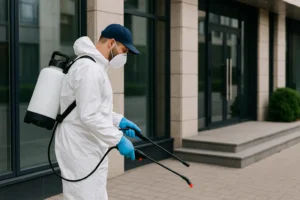
Fogging, ULV misting or targeted application clears the adults currently flying. This is the part you notice, and it belongs at stage four of a programme, once the water has already been dealt with. Your technician will tell you which areas to keep clear during application and when the space can be used normally again, and that instruction depends on the product and the area, so ask for it in writing rather than taking a number off a website.
5. Residual work and a follow-up that rechecks the list
A residual treatment goes on the shaded surfaces where adults rest through the heat: dense planting, shaded walls, the underside of garden furniture, service voids. Then a follow-up visit revisits every source recorded at stage one to confirm it has stayed clear, which is where you find out whether the irrigation was retuned and whether the drain was actually cleared.
If you want the fuller technical version of this sequence across property types, our mosquito control service page covers apartments and commercial premises alongside villas.
What moves the price
Several Dubai providers publish a fixed price ladder by bedroom count. That works for an apartment and works poorly for a villa, because bedroom count tells you almost nothing about how much water is on the plot.
The variables that actually move a villa quotation are the size of the irrigated and planted area, whether there is a pool and whether it is covered or idle, the presence of a permanent water feature, how many separate sources the inspection finds, whether any of them sit outside your boundary, and whether you want a single visit or a scheduled programme through the year.
We are not going to print a number here that we would then have to renegotiate on your driveway. What we would tell you to do with any quotation, ours included, is ask three things: how many visits it covers, whether larval treatment and a follow-up recheck are inside the price or extra, and what the provider does if the biting has not dropped after the follow-up. A quote that only prices a fogging visit will always look cheaper, and it is pricing a different job.
If you are comparing providers more broadly, our guide to the pest control companies approved by Dubai Municipality explains what that approval does and does not tell you.
Flies in a villa are the same problem in a different form
The flies in a garden are the end of a cycle that started somewhere else on the property. House flies point at bins and decaying waste, which in a villa usually means the bin store, the gap behind it, or a wheelie bin that is rinsed less often than it is filled. Small flies rising when a sink or an outdoor kitchen drain is used point at the organic film lining that drain. Fruit flies mean fermenting sugar somewhere: a bar area, a fruit bowl, a crate in the store.
Pet waste and animal enclosures are the villa-specific source most often missed, followed by the compost or green waste pile that landscapers keep behind the service wall. In summer humidity, wet organic waste turns over fast, and a bin store with a floor drain that does not drain is an excellent breeding site for both flies and mosquitoes at once.
The logic is identical to the mosquito logic: identify the species, trace it back to what is producing it, deal with that first, then use screening, residual treatment and light traps to handle what is left. Our fly control service sets out the species-to-source mapping in more detail, including the commercial kitchen version.
Dubai and Abu Dhabi are regulated by different bodies
In Dubai, pest control companies are approved through Dubai Municipality and its Public Health Pest Control Section, and approval takes the form of a No Objection Certificate rather than a public licence number. There is no number for a company to quote at you, which is why so many websites in this market show a badge instead. What is public is the list of approved companies, so the check available to a villa owner is to look for the company name on that list before booking anything.
Two things about that approval are worth knowing, because most pages blur them. The A, B and C grouping you may see quoted is a company size band, not a grade of competence or a quality tier. And Dubai Municipality’s own listings for those groups cover general pest control while excluding specialist categories such as fumigation, termite work and bird work, which are handled separately.
Abu Dhabi is a different regulator entirely. The Abu Dhabi Public Health Centre states that public health pest control services have been transferred under its mandate and that it issues and renews work permits for all public health pest control activities, so any company still advertising Tadweer approval for Abu Dhabi work is quoting something out of date. A Dubai Municipality approval carries no weight in Abu Dhabi, and Abu Dhabi publishes no equivalent public register, which means for an Abu Dhabi property you cannot look a company up the way you can in Dubai.
We wrote about that gap and how to work around it in our guide to pest control companies in Abu Dhabi, including the questions to ask when there is nothing to search.
What you can do this week, without a technician
Most residential mosquito pressure drops noticeably once these are handled, and none of them require a contract.
- Scrub, do not tip: empty and scrub plant saucers, buckets and pet bowls rather than pouring them out, in line with WHO’s advice to clean water containers weekly rather than only empty them.
- Follow the condensate: check every air conditioning drip tray and condensate outlet, and make sure each one discharges into a drain rather than onto a flat surface.
- Test the drains: pour a bucket down each balcony, terrace and car porch drain and watch how fast it goes. Slow is a plug forming.
- Look at the pool cover: sweep off any water sitting in the dips, and drain features and fountains that are switched off rather than leaving them part full.
- Retune the irrigation: reduce overshoot onto hard surfaces and look for the low point where run-off collects after a cycle.
- Fix the screens: repair window, door and balcony mesh, and check the seal around air conditioning penetrations where mosquitoes get in unnoticed.
- Walk the plot after rain: within a few days of any real rainfall, repeat all of the above. That is the window that matters.
Whether to call anyone at all
There is no universal answer here, and plenty of villas do not need a contract.
- Handle it yourself if: the biting started recently, your plot is small or lightly planted, you can find the water on the checklist above, and the pressure drops within a week or two of clearing it.
- Book an inspection if: you have already been fogged and it came back, the plot is large or heavily irrigated, there is a pool or permanent water feature, biting continues through the cooler months, or you have cleared everything you can find and it has made no difference.
That last case is the one worth spending money on, because it usually means the source is somewhere you cannot see or cannot reach: a communal drainage run, a neighbouring plot, a condensate line inside a service void, or a construction site over the wall. Establishing which of those it is tells you what actually has to change before the biting stops.
An inspection tells you where the mosquitoes on your property are actually coming from, which is the part most treatments never establish. Contact GRMC Pest Control today to book a villa inspection in Dubai or Abu Dhabi, and ask us for the written list of water sources we find.