Table of Contents
GRMC Pest Control is a family-owned pest control company in Dubai and Abu Dhabi. We were founded in 1990 and came to the UAE in 2008, when we opened in Abu Dhabi. Today we work from offices in Al Quoz Industrial Area 3 in Dubai and Al Khalidiya in Abu Dhabi, and we treat apartments, villas, restaurants, hotels, warehouses and offices in both emirates. In Dubai we are on Dubai Municipality’s published list of approved pest control companies, in the general pest control section, and every treatment we carry out comes with one offer: if the pest is still there after the treatment and the follow-up visit, you get your money back.
This page sets out the details you can check for yourself: what we treat, what a visit looks like from the first call to the follow-up, exactly where we appear on Dubai Municipality’s list and what that listing leaves out, and why Abu Dhabi works under a different regulator.
If you are comparing several companies rather than looking at us in particular, start with our guide to checking pest control companies in Dubai, which walks through the same checks for any name on your shortlist.
At GRMC Pest Control, we have kept this page to what we can show you, and the section near the end explains what we left off and why.
What follows is the plain version of who we are and how we work as a pest control company in Dubai and Abu Dhabi, with a link out to the full page for each service covered here and to the longer guide for each pest people most often call us about.
GRMC at a glance
The short version, for anyone deciding whether to call.
- Who we are: a family-owned pest control company, founded in 1990 and working in the UAE since 2008, when we opened in Abu Dhabi.
- Where we work: from offices at Dynatrade Commercial Complex in Al Quoz Industrial Area 3, Dubai, and in Al Khalidiya, Abu Dhabi, covering homes and businesses in both emirates.
- Who we work for: tenants, owners and landlords of apartments and villas, holiday home hosts, and commercial premises from restaurants and hotels to warehouses, offices and staff accommodation.
- Our Dubai listing: entry 135 in Group C of the general pest control section of Dubai Municipality’s list of approved pest control companies, August 2026 edition.
- Abu Dhabi: regulated by the Abu Dhabi Public Health Centre (ADPHC), which issues the work permits there. A Dubai Municipality listing does not carry across the emirate border.
- Our offer: “100% Pest-Free Or Money Back”. If the pest is still there after the treatment and the follow-up visit, you get your money back.
- Booking: the inspection is free, and one of our technicians gets back to you the same working day.
The pests we treat, and where to read more
Each service below has its own page, and the full list sits on our services page. Where we have written a longer guide for the situation people actually call about, it is linked alongside, and the descriptions say what the work involves in plain terms.
Cockroaches
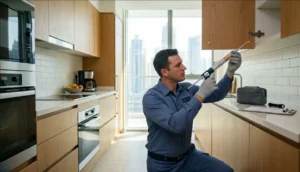
Most kitchen call-outs in UAE apartments turn out to be German cockroaches (Blattella germanica), living in cupboard hinges, appliance cavities and the warm space behind the fridge. The treatment is gel bait placed into those harbourages in small amounts, well away from the surfaces you cook on, because repellent sprays tend to scatter the population through the run of kitchen units. Our cockroach control service covers homes and food premises, and our guide to small cockroaches in the kitchen explains how to identify them and why supermarket spray so often makes the problem spread.
Bed bugs
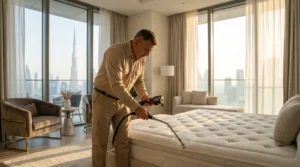
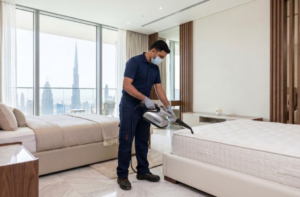
We quote bed bug work as two visits from the start. The first treats the seams, joints and gaps around where you sleep, and the second is timed to meet the bed bugs hatching from eggs that were already laid when the technician arrived. Our bed bug treatment service covers apartments, villas, hotel rooms, holiday homes and staff accommodation, and our bed bug treatment guide for Dubai sets out the reasoning, including where heat treatment falls short on the tiled floors of UAE homes.
Ants and rodents
Ant control relies on baits that the workers carry back to the nest, so the colony is dealt with where it lives instead of at the trail you can see on the counter. Rodent control combines secured bait stations, sealing the entry points the inspection finds, and monitoring afterwards, which matters in a villa with a garden and in any building where the service ducts are shared.
Mosquitoes and flies
In a villa, mosquito work starts with the standing water on the plot: plant saucers, blocked gullies, irrigation leaks and the drip from air conditioning condensate lines. Mosquito control treats those breeding sources and the shaded places where adults rest, and fly control follows the same logic of finding what the flies are breeding in first. Our guide to mosquito control for Dubai villas goes through where the water hides.
Bees and wasps
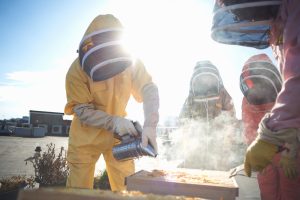
A honey bee swarm resting on a railing and a colony living inside a wall cavity or an air conditioning housing are different jobs, and a wasp nest is a third. For honey bees, relocating the colony is usually worth attempting first, and a cavity colony needs an inspection before anyone can tell you how the work will go. See wasp and bee removal, and read our guide to bee hive removal in Dubai before anyone sprays anything, because spraying or blocking a nest provokes the bees to defend it.
Termites, fumigation and birds
Dubai Municipality lists termite control, fumigation and bird control separately from general pest control, each in its own section of the same document, and our Dubai listing is in the general section. That is why none of the three appears in the list above. Whoever you are considering for one of these jobs in Dubai, check that the company appears in the matching section before you book, as the section on our Dubai listing further down explains. Our guide to bird and pigeon control in Dubai covers why pigeons keep returning to the same ledge and when netting beats spikes.
Programmes, for homes and businesses that want a schedule
Most homes and businesses are better served by a scheduled programme than by a call-out each time something appears. General pest control covers the common crawling and flying pests together on a regular visit. Our organic pest management programme uses low-toxicity products chosen for homes and premises with children and animals in them. Smart IPM adds connected traps and sensors that log activity as it happens, which is useful when an auditor asks for records between visits.
Some problems cannot wait for a normal appointment: a wasp nest beside a doorway, a rat inside a living space rather than the garden, or a sighting in a food business ahead of an inspection. Those go through emergency pest control, and if you are unsure which kind of problem you have, describe it when you call and we will tell you.
How a visit works, from the first call to the follow-up
The sequence is the same whether the job is a studio in International City or a hotel kitchen, and knowing it in advance makes the visit quicker for you.
The first call
Tell us what you are seeing, where in the property, roughly how many and for how long, and whether the property is a home or a business. Photos help a great deal, particularly for bees, wasps and anything you cannot identify. From that first conversation we can usually tell you whether the job needs a full treatment, a containment visit or simply some advice, and we say which before anyone is sent.
Access, sorted before the day
In most Dubai and Abu Dhabi towers and gated communities the technician needs a gate pass or a note to building management, some buildings need a service lift booked, and some only allow contractor work at set hours. Arrange this when you book, so the visit can start on time.
An inspection before any treatment
A visit is an inspection first and a treatment second. That order is the core of what the United States Environmental Protection Agency calls Integrated Pest Management, “an effective and environmentally sensitive approach to pest management that relies on a combination of common-sense practices”. In the EPA’s description, pests are monitored and identified accurately first, prevention is the first line of control, and a control method is chosen only once monitoring shows it is needed, judged “both for effectiveness and risk”. Dubai Municipality’s own Public Health Pest Control Section lists integrated pest management “according to International Best Practices” among its functions.
In a UAE property that means the technician looks for the conditions keeping pests alive as well as the pests themselves: moisture under sinks and behind appliances, gaps around service pipes and under doors, food debris in the places nobody cleans, and droppings, shed skins or grease marks along the routes pests travel. In a tower it also means the connections you share with the rest of the building, such as drainage stacks, service risers, district cooling voids and the refuse chute room on your floor.
Treatment placed where the inspection found activity
Two flats of the same size rarely get identical work, because the treatment follows what the inspection found. Baits and residual products go into cracks, voids, harbourages and entry routes, and open floors and worktops are left alone. Ask for the names of the products before the visit, and ask how long children and pets should stay out of each treated room, because the answer differs between a gel bait placed inside a hinge and a residual product applied along a skirting line.
A written record of the visit
You should finish every visit with a written record of what was found, where, what was applied and when the follow-up is booked. For a tenant, a landlord, a holiday home host or a food business, that record is the document you will need later, whether the person asking is a landlord, a booking platform or an inspector.
The follow-up visit
For pests whose eggs survive a first treatment, bed bugs and German cockroaches above all, the follow-up is booked at the same time as the first visit and written into the quote from the start. It is there to deal with what hatched after the first treatment and to confirm whether the problem has gone, and it is also the visit our money-back offer is measured against.
The money-back offer, in its actual terms
Our offer is “100% Pest-Free Or Money Back”, and its terms are short. If the pest we treated is still there after the treatment and the follow-up visit, you get your money back.
That is why the follow-up visit carries so much weight in how we quote. A company that tells you a pest will never come back is promising something nobody controls. Bed bugs arrive in a suitcase, German cockroaches arrive in grocery cardboard, and in a tower the flat next door is part of your problem whether or not anyone treats it. Our offer is tied to something both of us can check on the day, which is whether the problem you called us about is still there once we have treated it and come back.
Ask for the offer to be written on your quotation, and keep the written record from each visit, because those two documents make any claim straightforward.
Checking us the way you would check any pest control company in Dubai
Dubai Municipality clears pest control companies through its Public Health Pest Control Section. The Section’s own page lists “Issuing No Objection Certificates (NOC) for Public Health Pest Control companies operating in Dubai, prior to obtaining the trade license” among its functions, together with “Regulating and qualifying these companies and assessing their pest control programs”. There is no public licence number in this system to quote or look up. What the Municipality does publish is its list of approved companies, and that list is the check worth running on anyone you are about to book, us included.
Where we appear on the list
The current edition of Dubai Municipality’s list of approved pest control companies is dated August 2026 and runs to 54 pages. We appear once, at entry 135 on page 19, in Group C of the general pest control section, under our registered name “G R M C FOR PUBLIC HEALTH PESTS CONTROL SERVICES CO. L.L.C”. Search the document for that name, since the brand on our vans is shorter than the name the Municipality uses.
The guidance notes on the first page of the same document are worth reading too. The Municipality states there that its No Objection Certificate “indicates that the Company meets the minimum professional requirements” and that it “must not be consider[ed] as publicity or recommendation”. A listing shows that a company meets the Municipality’s minimum standard for working in Dubai. It does not rank the companies on it.
What Group C means
In the words of the August 2026 list, the companies in the general section “are divided into 3 groups as per the number of pest control qualified manpower”. The same page sets the bands: Group A is more than 25, Group B is 11 to 25, and Group C is 1 to 10. Group C therefore describes our size by the Municipality’s own measure, and the list does not grade how well any company treats a kitchen or a bedroom. Size does matter if you are scheduling work across a large portfolio on a fixed cycle, and in that case the right move is to ask us directly about capacity for your schedule before you sign.
What the general section covers, and what it leaves out
The page that opens the general section describes those companies as “licensed for general pest control operations excluding fumigation, termite control and bird control”. Those three scopes are published as separate sections further into the document, each with its own numbering. Our listing is in the general section only. For a Dubai job involving termites, fumigation or bird proofing, find the company you are about to book in the matching section of the document before you agree the work.
The ID card at the door
The guidance notes also say that all pest control company staff “must carry Pest Control ID card issued by Public Health Pest Control Section”, and that customers “should make sure that the employees of these Companies carry this card”. Ask our technician for it when they arrive and check the name against the person in front of you. For the complete method, including how to check a company that has already quoted you, see our guide to Dubai Municipality approved pest control.
Abu Dhabi works under a different regulator
A Dubai Municipality listing is a Dubai credential, and it carries no weight in Abu Dhabi. There, public health pest control sits with the Abu Dhabi Public Health Centre (ADPHC). The Centre’s own page says that “the public health pest control services have been transferred under our mandate”, that it “will issue and renew work permits for all public health pest control activities”, and that the licensing process for commercial providers of public health pest control “has now been moved to ADPHC”, with applications made through the TAMM platform.
Abu Dhabi does not publish a searchable list of permitted companies the way Dubai does, so the quick name check that works in Dubai has no equivalent there. For an Abu Dhabi property, ask the company for its permit documentation and read it before the visit, and run the same check on us.
Our Abu Dhabi office is in Al Khalidiya. For the way we assessed the Abu Dhabi market company by company, including what we could not verify about anyone there, ourselves among them, see our guide to pest control companies in Abu Dhabi.
Homes: apartments, towers and villas
What a home visit involves depends on the type of building as well as on the pest.
Apartments and towers
In a tower, cockroaches and rodents move through the building instead of staying inside one flat. Shared drainage stacks, service risers, district cooling voids and the refuse chute room on each floor connect units that never see each other, so treating one apartment on its own can buy a few quiet weeks before the population walks back in from next door.
Before you book a private treatment, ask your facilities manager or owners association two things: whether the building already holds a scheduled pest control contract, and when the common areas were last treated. In many towers and master communities that work is already paid for through the service charge, and a tenant and landlord argument over who pays sometimes ends there. UAE winters are mild and most homes stay climate-controlled through the year, so cockroaches and bed bugs indoors get no cold season to slow them down, and a problem left alone over the winter months does not fade on its own.
Villas
In a villa the garden and the outside walls become part of the job. Irrigation, planters and condensate lines hold standing water for mosquitoes, gardens and boundary walls give rodents cover, and bees look for cavities in walls and air conditioning housings. Pigeons settle on ledges, parapets and the platforms that carry the outdoor units. Termite activity usually shows first as mud tubes on a ground-floor wall or as woodwork that sounds hollow when tapped. In Dubai, termite control and bird control each have their own section on the Municipality’s list, so for either job on a villa, check that the company you book appears in the matching section.
Businesses: restaurants, hotels, warehouses and offices
Commercial work differs from a home visit because the record matters as much as the treatment. A food business, a hotel or a warehouse needs a schedule it can show an inspector, a written record of every visit, and methods that fit around the hours it operates.
Food businesses in Dubai
Dubai Municipality’s Food Code, in the English edition the Municipality publishes on its website, is explicit about who does the work. Pest control in food premises “shall be done by specialist pest control agencies licensed and approved by the concerned Department to operate in Dubai, utilising approved chemicals and methods”, and “the food establishment has the primary responsibility to ensure that a competent person carries out the pest control operation in the premises”. The responsibility stays with the business even when the work is contracted out, which is why a food business should keep the record of every visit where it can produce it on request.
The same section of the Food Code covers how the work is done around food. It says rodenticides and insecticides “should not be applied while food production / preparation is taking place”, and that where a 24-hour operation makes that impossible, “reliance on physical control methods are preferred to the use of chemicals”, sprays especially. The Food Code places electric fly killers at least 1.5 metres, and preferably 4.5 to 6 metres, from a food handling area and never directly above food preparation or storage. The Food Code also asks for door thresholds with no more than 6 mm of clearance and metal kick plates to keep rats and mice out, and for refuse to be cleared at least once a day.
We build commercial programmes around those requirements: visits outside service hours wherever the operation allows, gel baits and physical methods near food in preference to sprays, monitoring points placed where they can be checked, and a written record left after every visit.
Hotels, holiday homes and staff accommodation
Hotels and licensed holiday homes run on a faster clock, because the room is revenue and a guest complaint or a booking platform dispute will ask what was done and when. For these clients the report and the schedule are as much the deliverable as the treatment. Staff accommodation needs the work planned across the whole block at once, since shared rooms and belongings stored under beds let one untreated room seed the rest.
Warehouses and offices
Warehouses bring rodents, pests of stored goods, loading bays that stay open for most of the day, and stock that cannot be moved for a treatment. If a consignment or a store room needs fumigation, that has its own section on Dubai Municipality’s list, so check that the company planning the fumigation appears in it. Offices are usually the simplest commercial sites, with most activity in pantries, washrooms and the voids above suspended ceilings.
For a food business in Abu Dhabi, the Dubai Food Code is not the rulebook that applies. Ask your own food safety inspector which records they expect to see, and ask any contractor, us included, for its ADPHC permit documentation before the contract starts.
What you will not find on this page
There are no star ratings, review counts, customer numbers or testimonials here. None of them can be checked from outside a company, so we have left them off. If you want to judge us by what customers say, read how we reply to complaints before you look at the average, and our guide to reading pest control company reviews in the UAE explains what to look for in anyone’s reviews, ours included.
There are no prices either. A headline figure set before anyone has seen the property is either an entry price that will change or a number with nothing behind it, and neither helps you compare quotes. We quote after the inspection, in writing, with any follow-up visit the job needs already written into the figure. When you compare us with other companies, compare the number of visits, the written record and what happens if the pest remains, as well as the price.
Frequently asked questions
Is GRMC Pest Control approved by Dubai Municipality?
Yes. GRMC appears in the August 2026 edition of Dubai Municipality’s list of approved pest control companies, at entry 135 in Group C of the general pest control section, under the registered name G R M C FOR PUBLIC HEALTH PESTS CONTROL SERVICES CO. L.L.C. Dubai Municipality states that the general section covers general pest control operations excluding fumigation, termite control and bird control, which it lists in separate sections. For a Dubai job in any of those three scopes, check that the company you book appears in the matching section.
What does Group C mean on the Dubai Municipality list?
It is a headcount band. Dubai Municipality’s August 2026 list divides general pest control companies by their qualified pest control manpower, with Group A above 25, Group B from 11 to 25 and Group C from 1 to 10. The letter describes the size of a company, and the list does not grade how well any company treats a property.
Does GRMC work in Abu Dhabi?
Yes. GRMC has an office in Al Khalidiya, Abu Dhabi, as well as its Dubai office in Al Quoz Industrial Area 3. In Abu Dhabi the Abu Dhabi Public Health Centre (ADPHC) states that it issues and renews work permits for all public health pest control activities, and Dubai Municipality approval does not apply there. ADPHC publishes no public list of permitted companies, so ask any company, GRMC included, for its permit documentation before the visit.
What does GRMC’s money-back offer cover?
GRMC’s offer is “100% Pest-Free Or Money Back”: if the pest GRMC treated is still there after the treatment and the follow-up visit, you get your money back. Ask for the offer to be written on your quotation, and keep the written record GRMC leaves after each visit.
How does a GRMC pest control visit work?
It starts with a free inspection, in which the technician looks for the pests and for the conditions keeping them there, such as moisture, gaps around pipes and food debris. Treatment is then placed in the cracks, voids and harbourages the inspection found, and you receive a written record of what was found, what was applied and when the follow-up visit is booked. For pests whose eggs survive a first treatment, such as bed bugs and German cockroaches, the follow-up is scheduled from the start.
How much does pest control cost in Dubai?
GRMC does not publish a fixed price, because the figure depends on the property, the pest, how far it has spread and how many visits the job needs. The inspection is free and the quote is given in writing after it, with any follow-up visit the job needs written into the figure. When comparing quotes, compare the number of visits, the written record and what happens if the pest remains, as well as the price.
Is GRMC pest control suitable for homes with children and pets?
GRMC places treatment in cracks, voids and harbourages instead of spraying open floors and worktops, which limits contact with the surfaces children and pets touch. Ask for the product names before the visit and for the re-entry time for each treated room, since a gel bait inside a hinge and a residual product along a skirting line need different precautions. For homes that want low-toxicity products, GRMC runs an organic pest management programme using products chosen for homes with children and animals in them.
Do restaurants in Dubai have to use an approved pest control company?
Dubai Municipality’s Food Code states that pest control in food premises shall be done by specialist pest control agencies licensed and approved by the concerned Department to operate in Dubai, utilising approved chemicals and methods. The same clause gives the food establishment the primary responsibility to ensure that a competent person carries out the work. Keep the written record of every visit where you can produce it for an inspector.
Book an inspection
Tell us what you are seeing and where, and whether the property is a home or a business, and we will arrange the inspection. When the technician arrives, run the same checks on us that this page describes: the registered name on Dubai Municipality’s list for a Dubai job, the permit documentation for an Abu Dhabi job, the Pest Control ID card at the door, and the money-back offer written on the quotation.
Contact GRMC Pest Control to book a free inspection at your home or business in Dubai or Abu Dhabi.
Details on this page were checked on 21 September 2026 against the August 2026 edition of Dubai Municipality’s Approved Pest Control Companies list (form DM-PHSD-P3-FO122-APCCFO), Dubai Municipality’s Public Health Pest Control Section page, the English edition of the Food Code published by Dubai Municipality, and the Abu Dhabi Public Health Centre’s pest control services page. Editions and listings change, so check the current documents before you rely on them.