Table of Contents
Termite control in Dubai starts in the soil around the villa. Every termite species recorded in the UAE’s national termite survey lives underground and reaches wood through earthen tunnels, so protecting doors, frames, skirting and wardrobes comes down to the ground around the house. Keep irrigation and air conditioning condensate off the walls, remove any timber touching soil, keep the foot of the walls visible, have the property inspected every year, and give any treatment to a company that Dubai Municipality lists specifically for termite control.
That survey is worth knowing about, because few pages on this subject cite it. It was carried out by W. Kaakeh of the Department of Arid Land Agriculture at United Arab Emirates University, with field sampling between March 2000 and May 2002, and published in 2005. It covered all seven emirates, identified six termite species, and found all six in both Dubai and Abu Dhabi. The species several Dubai pest control websites present as the main villa pest, the Asian subterranean termite Coptotermes gestroi, is not one of them.
This guide sets out what the survey found, how termites get from the soil into a UAE villa, the signs worth checking yourself, the part of the problem that is in your hands, and how to confirm that whoever treats your property is allowed to do termite work in your emirate.
At GRMC Pest Control, a family-owned company founded in 1990 that now works from offices in Dubai and Abu Dhabi, we think the most useful thing we can give a villa owner worried about termites is a straight account of what is in the ground, how it is getting in and who should deal with it. That includes being clear about ourselves. Our Dubai Municipality listing is on the general pest control list, which excludes termite work, so in Dubai our part in a termite problem is the inspection and the advice.
This guide is a practical walkthrough of termite control in Dubai for villa owners, tenants and anyone about to take the keys to a property with timber in it, so that you can protect the woodwork and read a termite quote knowing what each line means.
Termite control in Dubai at a glance
The short version, before the detail.
- The colony is in the ground: the UAE survey found that all six recorded species are subterranean and reach wood through earthen gallery systems, so termites in a door frame are connected to the soil somewhere.
- Water sets the risk: in a climate this dry, irrigation, leaks and air conditioning condensate supply most of the damp soil that termites need, and that is the part of the risk a household controls.
- Wood is only part of what they eat: the survey recorded damage to stored wood, furniture and paper, and to non-cellulose items such as carpets, leather and rubber.
- The signs are easy to miss: earth tubes on walls, wood that is thin under the paint, and discarded wings after a humid spring evening are the ones to look for.
- Termite work has its own listing in Dubai: Dubai Municipality publishes a separate termite control list, and a company on the general list is not approved for termite work by that listing alone.
- Abu Dhabi has a different regulator: the Abu Dhabi Public Health Centre issues pest control work permits there and publishes no public register, so ask to see the paperwork.
Which termites the UAE’s own survey found
In its author’s words, the survey was “the first attempt to identify the termite fauna of the UAE”, and it remains the reference point for anyone who wants to know what is actually living in the soil under a Dubai or Abu Dhabi villa.
Six species, all of them underground
The survey’s field teams collected termites from infested plants and materials at 115 sites in Abu Dhabi, 46 in Dubai and smaller numbers in the other emirates, and specimens were sent to the British Museum of Natural History to confirm identification. The paper in the Journal of Agricultural and Marine Sciences names six species: two harvester termites, Anacanthotermes ochraceus and Anacanthotermes ubachi; the sand termite Psammotermes hypostoma (also spelled hybostoma); and three it groups as small waxy termites, Microcerotermes diversus, Heterotermes aethiopicus and Microtermes najdensis. Only H. aethiopicus had been recorded in the country before, from a colony infesting a house in Al Ain.
The paper’s summary sentence is the one that matters most to a homeowner: “All species were subterranean in habitat and reach wood sources through earthen gallery systems.” Across the country the dominant species was A. ochraceus, followed by P. hypostoma and M. diversus. The survey’s Dubai figures tilt the other way: the sand termite turned up at 20 of the 46 Dubai sites, the harvester termite at 13 and M. diversus at 6. The paper also reports that in the two largest emirates together, the harvester and sand termites made up more than 70 percent of the termites recorded.
As for which of them damage houses, the survey records damage to wood in residences and historical buildings by every species it found except M. najdensis, and in Abu Dhabi and Dubai that damage came mainly from A. ochraceus and P. hypostoma. Those two were found attacking the roofs of historical buildings and damaging construction timber and furniture, and in many cases they had removed the straw from the mud bricks of rural houses, especially in Dubai and Abu Dhabi. Stored wood and wood products such as furniture were attacked by all six species in every emirate. The harvester termite takes its name from feeding on dry grass and plant debris at the soil surface, and it is sometimes written off as a garden insect for that reason. The survey’s records of building damage put it alongside the sand termite.
What the survey did not find, and the Coptotermes question
The survey recorded no drywood termites, the kind that live entirely inside a piece of dry timber with no connection to the ground. The practical consequence is the most important point in this guide. If the termites in your wardrobe or door frame are one of the species on that list, the colony is in the soil and the wood is where it is feeding, so treating the furniture alone deals only with the part you can see.
It also recorded no Coptotermes of any kind. The picture has moved on since 2005, and it is worth being precise about how. A 2021 review of the termites of the Arabian Peninsula, published in the Saudi Journal of Biological Sciences, lists 30 known species for the peninsula and gives the range of Coptotermes heimi as including the UAE and Oman. The review’s own catalogue entry notes that a 2010 study treated that name as a synonym of C. gestroi. The same authors record it as new to Saudi Arabia and describe it as appearing rare in the region. So the genus is present in the literature for this country. What we could not find is any published evidence that it is the dominant termite in Dubai homes, which is how several local websites present it.
If what you find is dry, gritty pellets piling up below a small hole, with no earth anywhere, that is a different pattern. The University of Florida’s extension service, in its homeowner guide Termite Prevention and Control, describes drywood termite evidence as six-sided pellets pushed out through holes about the size of a pen tip, and notes that drywood colonies are not connected to the ground, so their galleries have no mud in them. The 2021 review adds that drywood termites are easily transported from region to region, where most subterranean species stay within their native range. Since the national survey recorded no drywood species, a find like that is worth having identified before anyone treats. UF/IFAS suggests collecting as many insects as you can in a small, tightly sealed container of rubbing alcohol or hand sanitiser, and notes that winged swarmers and soldiers are the most useful for identification.
The sand termite, and why dry sand is no reassurance
The sand termite deserves its own paragraph because it is the species the survey found most often in Dubai. The paper describes it living in sandy soil through which water drains quickly, where it can tunnel down to the water table, and it cites an earlier report of P. hypostoma found 30 to 40 metres below the surface. The top few centimetres of a garden being bone dry in August tells you very little about what is underneath.
The survey found it feeding on wood, plant debris and living plants, and attacking the roofs of historical buildings and residences in Abu Dhabi and Dubai. Its author also expected the large-scale creation of woodland in parts of the country to widen the range of habitat suitable for subterranean termites, naming the sand termite, the harvester termite and M. diversus in particular. Our reading is that an irrigated, planted villa plot is the same change on a small scale.
Date palms in the garden
Date palms were attacked by all six species at various levels. The most common form of attack the survey recorded was hollowing out of the palm roots, which it says may be followed by yellowing and death, especially in young trees and offshoots. A palm that is yellowing for no obvious reason, particularly a young one planted close to the villa wall, belongs in a termite inspection.
How termites get from the soil into villa woodwork
Most UAE villas are built of concrete and block, which termites do not eat. What they eat is the timber and paper fitted into that structure and stored against it, and the route between the soil and that timber is where protection works.
Tunnels, tubes and the timber closest to the ground
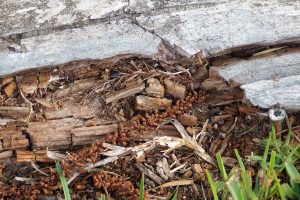
Subterranean termites travel inside earth. Where they have to cross something exposed, they build shelter tubes, which the University of California’s integrated pest management programme calls “the most commonly seen evidence of a subterranean termite infestation”. UF/IFAS describes the tubes as made of soil, termite faeces and partly digested wood, and notes that subterranean termites feed along the grain, sometimes leaving only a thin veneer of undamaged wood at the surface. That is why an inspector probes and taps skirting, door frames and thresholds.
In a villa, the timber to watch is the timber nearest the soil: ground-floor door frames and thresholds, skirting boards, the bases of built-in wardrobes and kitchen units, under-stair cupboards, and anything in the garden made of wood, from pergola posts and decking to planter boxes and fencing. The survey adds a point that is easy to forget. It recorded termites in paper, and in non-cellulose items such as carpets, leather and rubber, so the storeroom, the garage and the staff room where boxes sit on the floor for years deserve as much attention as the joinery.
The ways in are the gaps every concrete structure has: expansion joints, the junction between the floor slab and the wall, the openings where pipes and cables come up through the slab, and door frames that sit directly on soil or paving. UF/IFAS shows a tube at a garage door skirting and frame as a typical example and calls it “a common entry point”.
Why irrigation matters more than rain here
Subterranean termites need moisture. UC IPM puts it plainly: they “require moist environments”, and to satisfy that need they usually nest in or near the soil. The UAE survey notes that all six species occur in Abu Dhabi and Dubai, where less than 100 mm of rainfall is usually recorded, and it opens by linking the rise of termites as pests of crops and buildings to desert and marginal land being irrigated. Around a villa, most of the moisture a colony uses is supplied by the household.
It comes from the drip line in the flower bed against the wall, the sprinkler that wets the wall every evening, the air conditioning condensate pipe draining onto the soil at the foot of the villa, the planter that is watered daily and stands against the wall, and the slow leak under a ground-floor bathroom. UF/IFAS names several of these directly, telling homeowners to direct irrigation heads away from walls, direct A/C drainage lines away from the house and fix leaks, and it describes wet walls as a condition that “will allow termites to thrive”.
Timing works against you too. The survey found that workers of most species forage in the open from late afternoon to early morning, and it collected winged adults after their swarming flights on humid days or at night at the beginning of spring. Activity that happens after dark is activity a household rarely sees. The US Environmental Protection Agency makes the same point from a different market: “Most people are not aware they have termites until they see a swarm or come across damage during construction.”
The signs to check, and what they are not
A useful first check needs a torch and a flat screwdriver. Work around the outside of the villa first, then the ground floor inside, then the garden and the storerooms.
- Earth tubes: narrow tubes of earth running up an external wall, a boundary wall, the side of a step or the back of a cupboard. If you find one, photograph it and leave it in place for the inspector, because an intact tube shows where the termites are coming in.
- Wood that is thin under the paint: UC IPM describes damaged wood as “typically thin at the surface and easily punctured with a knife or screwdriver”, and lists darkening or blistering of the wood as another possible sign. The EPA suggests probing exposed wood for hollow spots with a flathead screwdriver. Press gently along skirting and the bottom of door frames.
- Earth where it should not be: soil packed into the joint around a door frame, along an expansion joint or inside a timber threshold.
- Wings on sills and under lights: small piles of shed wings the morning after a humid evening, especially early in spring.
- Damaged stored items: boxes, papers, rugs or timber in a storeroom that have earth in them or crumble when lifted.
- A yellowing palm: particularly a young palm or offshoot, given the root damage the survey recorded.
Flying ants are a common false alarm, and the EPA notes that ant swarms are sometimes mistaken for termites. Its comparison is the quickest check: termite wings are “roughly equal in length” and the antennae are straight, while ants have front wings longer than the hind wings and antennae “bent at ninety degree angle”. UC IPM adds the waist to that checklist, and UF/IFAS notes that most people can see the waist on an ant. UC IPM also cautions that seeing a swarm does not always mean the building itself is infested.
Blistered paint on a skirting board can also be ordinary damp. The difference shows once the surface is opened. UC IPM describes termite excavations as hollow, completely enclosed cavities that generally follow the grain of the wood, and subterranean species leave earth in their galleries. UC IPM’s advice is that a professional inspection of the structure is usually required to confirm an infestation, and that is the right order of events before anyone quotes for treatment.
Protecting the woodwork: the part that is in your hands
Treatment is one half of termite control. The other half is removing the conditions that let a colony reach the wood, and most of it costs little. UF/IFAS summarises prevention for homeowners as minimising moisture, minimising food sources and making the house easier to inspect. Adapted to a UAE villa, that looks like this.
- Take the water off the walls: turn sprinkler heads away from the villa, pull drip lines back from the wall and water the beds against the house less. If a landscaping company maintains the garden, ask it to make the change on its next visit.
- Send the AC condensate somewhere else: a condensate pipe that empties onto soil at the foot of the wall keeps that spot damp all year. Redirect it to a drain or away from the building, as UF/IFAS advises for A/C drainage lines.
- Fix leaks promptly: external taps, ground-floor bathrooms and any pipe that runs under a slab near the wall.
- Plant away from the walls: UF/IFAS recommends keeping plants at least 2 feet, about 60 centimetres, from exterior walls and allowing for future growth. It also says branches must not touch the roof, since termites can use them as bridges.
- Keep the foot of the wall visible: UF/IFAS recommends an inspection space of at least 6 inches, about 15 centimetres, between the soil or mulch line and the wall covering, so that tubes can be seen. In a UAE garden, that means not banking soil, bark or decorative stone up against the villa.
- Break wood-to-soil contact: timber fencing, decking, pergola posts, garden edging and play equipment should not sit in soil. UF/IFAS advises eliminating wood-to-ground contact and specifically avoiding wooden landscape timbers for edging.
- Store off the floor and away from external walls: UF/IFAS warns against keeping items that hold moisture at ground level within 2 feet of the foundation. Boxes, spare timber, old furniture and rolled carpets in a ground-level store are exactly the food sources the survey found termites using.
- Book a regular inspection: UF/IFAS suggests an annual renewal inspection by someone trained to recognise termites, while UC IPM, writing for California, suggests inspections every three to five years. With irrigation running every day of the year here, we would lean towards the annual check for a villa with a garden.
None of this replaces treatment where a colony is already feeding. It does decide how long any treatment keeps working. UF/IFAS warns US homeowners that improper plant placement may void a termite warranty and that moisture can void some warranties too, so read any contractor’s written terms here for conditions of the same kind before you sign.
Treatment options, explained so you can read a quote
Termite treatment is professional work, and the choice of method belongs to an inspection. What follows is enough to understand what is being proposed and to ask sensible questions about it. The product examples come from UF/IFAS guidance written for the US market, so ask any UAE contractor for the name of the product it intends to use and for a copy of its label.
Liquid soil treatment
UF/IFAS describes liquid soil termiticides as still the most common method of termite control both before and after construction. For an existing building, the technician trenches along the perimeter and may drill through the slab to get product into soil that cannot otherwise be reached. One line in that guidance is worth repeating to anyone drilling around a villa: the technician “must understand building construction in order to know that the drill will emerge under the slab”.
That carries extra weight in a UAE villa, where the perimeter is often interlock paving, marble or porcelain laid over concrete. Before work starts, ask where the holes will go, through which finishes, how they will be sealed, and who replaces a tile that cracks.
On how long it lasts, UF/IFAS gives a range for soil termiticides of two to more than fifteen years, depending on applying the correct amount, the soil type and the conditions. It also states that soil termiticides “do not generally kill entire colonies as can occur with some termite baits”, while providing structural protection when applied properly and maintained. Treated soil that is later dug up for new planting or an irrigation repair has been disturbed, which is worth remembering the next time the landscapers arrive with a trencher.
Baiting systems
Bait stations are set into the ground at intervals around the building, holding cellulose material that contains an insect growth regulator. According to UF/IFAS, the termites have to find the stations and feed on them for baits to work, and baits can be effective in buildings that are difficult to treat with liquids, which can include a villa whose owner does not want the paving drilled.
The trade-off is time. UC IPM says bait systems “may take several months or even years to control the problem and must be followed up with constant monitoring”. A bait programme is therefore a series of visits, and a quote for one should say how often the stations are checked, for how long, and what each check involves. UF/IFAS gives baits a longevity of four to seven years or more, and indefinitely as long as the system is maintained.
Wood treatment and replacement
UF/IFAS describes borate products based on disodium octaborate tetrahydrate as a common way to protect wood against termites and wood-decay fungi, and lists wood preventative treatment as protecting treated areas only. It is worth asking about for a new pergola, a deck or new ground-floor joinery. The same guidance warns that borates are toxic to plants, which matters when the timber stands in a planted bed. Badly damaged joinery gets replaced, and replacing it without dealing with the route in from the soil simply gives the colony fresh wood.
Pre-construction treatment, for anyone building
If you are building a villa, the stage before the slab is poured is the only point at which the soil underneath can be treated without drilling through the finished floor. UF/IFAS notes that liquid soil treatment is also the most common method at that stage.
You will often read that pre-construction anti-termite treatment is a legal requirement for a building permit or a completion certificate in Dubai. We looked for the Dubai Municipality regulation or building code clause that says so and could not find it, so we are not going to state it as a rule. Ask your consultant or main contractor what your own project’s approvals require.
Whatever the approvals say, keep the record: which company did the work, whether it appears on Dubai Municipality’s termite list, which product was used and at what stage, which areas were treated, and the date. If you are buying a newly completed villa, ask the developer for the same record at handover. A treatment nobody can document is hard to rely on ten years later, when you are trying to work out whether a problem is new.
What no treatment can do
No termite treatment changes the irrigation, the planting or the storage around a villa. Treated soil can be disturbed, bait stations can be left unchecked, and a colony under the neighbouring plot is outside anyone’s contract with you. A company that promises the problem will never come back is making a claim the biology does not support, so ask it to set out in writing what that promise actually covers.
Who is allowed to treat termites in Dubai and Abu Dhabi
This is the check that matters most before anyone drills around your villa, and it works differently in each emirate.
Dubai: termite control is a separate list
Dubai Municipality’s Public Health Pest Control Section issues No Objection Certificates to pest control companies before they obtain a trade licence, and it publishes the list of approved pest control companies. The detail that matters for a termite job is inside that document. The main list, in the Municipality’s words, covers companies “licensed for general pest control operations excluding fumigation, termite control and bird control”. Termite control has its own list, headed “Pest Control licensed for: Termite Control”, and in the August 2026 edition it holds 163 companies.
So a termite job needs one extra step in the usual check. Ask for the company’s full registered name in writing, open the current edition of the list, and look for that name in the termite section specifically. A company can be properly approved for general pest control and still not be listed for termite control. We go through the whole check, including the technician ID card to ask for on the day, in our guide to Dubai Municipality approved pest control.
That check applies to us as well. In the August 2026 edition, GRMC appears at entry 135 of the general list, in Group C, under the registered name G R M C FOR PUBLIC HEALTH PESTS CONTROL SERVICES CO. L.L.C. The list itself defines the group letters by headcount, with Group C covering companies of one to ten qualified staff, so the letter is not a quality grade. We do not appear in the termite section, which is why this guide describes our role in Dubai as inspection and advice.
Abu Dhabi: ADPHC, and no public register
In Abu Dhabi the regulator is the Abu Dhabi Public Health Centre. Its own page states that public health pest control services “have been transferred under our mandate” and that the Centre “will issue and renew work permits for all public health pest control activities”, with licensing for commercial pest control providers now handled by ADPHC through the TAMM platform. ADPHC gives no date for that transfer, so neither do we.
A Dubai Municipality approval carries no weight there, and ADPHC publishes no public list of permitted companies, so the Dubai-style lookup is not available. For an Abu Dhabi villa, ask the company, us included, to show the ADPHC permit documentation that covers the work it is proposing. We explain how to assess a company in an emirate without a public register in our guide to pest control companies in Abu Dhabi.
Questions to put to any termite contractor
- The listing or permit: ask which one covers termite work. In Dubai that is the termite section of the Municipality’s list, and in Abu Dhabi the ADPHC permit documentation.
- The findings: ask what was found and where the termites are getting in. A quote that names no entry point and no evidence is a quote for a generic job.
- The product: ask for its name and a copy of the label, which sets out how it has to be applied. It is reasonable to want to know what is going into the soil around your home.
- The drilling: ask where the holes will go and who reinstates the finish, and get the answer in writing before any drilling starts.
- The monitoring schedule: for a bait programme, ask how often the stations are checked and for how long, and make sure those visits are written into the quote.
- The written terms: ask what they cover and what voids them. UF/IFAS tells homeowners to read contracts carefully, so check how moisture, new planting and building work against the walls are treated in yours.
For the wider set of checks we suggest before letting any company into a property, see our guide on how to check a pest control company in Dubai before you book.
What moves the price of termite work
There is no termite price on this page. A headline figure set before anyone has seen the plot is either an entry price that will change or a number with nothing behind it. These are the variables that actually move a quote, so you can compare two of them properly.
- Perimeter length and surface: how many linear metres need treating, and whether the contractor is working into open soil or drilling through paving and tiles.
- Method: a liquid treatment is priced mainly on the application itself, while a bait programme is priced over months of monitoring visits.
- Extent: one door frame with a clear entry point is a different job from activity along two sides of the villa, the garden structures and the palms.
- Stage: treating soil before the slab is poured is a different operation from treating around a finished, landscaped villa.
- Repairs: joinery replacement and reinstating finishes may be quoted separately, so ask whether they are in the figure.
For the wider picture of how pest control is priced and regulated here, see our Dubai pest control costs and laws guide.
What we cannot tell you
The survey this guide leans on is from 2005 and was the first of its kind. Its author called for further work, including on the extent of damage termites do to local and imported wood. It is the only UAE-wide field survey we have been able to read, so the species picture here is the best published one we know of, and it should be read as that rather than as a current census.
We could not find a published calendar of termite swarming for the UAE. The survey collected winged adults at the beginning of spring, on humid days or at night, and anyone quoting you exact swarm months is going further than the published evidence we have seen.
We could not find the regulation that makes pre-construction treatment compulsory in Dubai, as explained above, and Abu Dhabi publishes no register to check any company against, ours included.
And nobody can tell you from a website whether your villa has termites. What we can do is look. A GRMC termite inspection covers the ground-floor timber, the perimeter, the irrigation and drainage against the walls, the storerooms and the garden. We tell you what we found, what to change around the house, and, where treatment is needed in Dubai, to check the contractor you choose against the termite section of the Municipality’s list.
If you have found tubes, soft skirting or wings on a sill, do not wait for the next spring to confirm it. Contact GRMC Pest Control to book a termite inspection for your villa in Dubai or Abu Dhabi.
Sources on this page were read on 21 September 2026: W. Kaakeh (2005), “Identification, Geographical Distribution and Hosts of Subterranean Termites in the United Arab Emirates Arid Ecosystem”, Journal of Agricultural and Marine Sciences 10(1): 33 to 40; the 2021 Arabian Peninsula termite review in the Saudi Journal of Biological Sciences 28(12); UF/IFAS publication ENY-2044/IN1277, Termite Prevention and Control; UC IPM’s Pest Notes on subterranean and other termites; the US EPA’s termite guidance; the August 2026 edition of Dubai Municipality’s Approved Pest Control Companies list; and ADPHC’s pest control services page. Editions and listings change, so check the current documents before you rely on them.