Commercial pest control in Abu Dhabi needs a documented programme, not only a treatment visit. Start by checking the contractor’s current authorisation, inspecting how pests enter the premises and agreeing who handles corrective work. Keep monitoring and service records that show what was found, what changed and what still needs attention.
A restaurant kitchen, dry-goods store and warehouse have different pressures. Deliveries, waste storage, equipment voids and loading doors can create different entry and harbourage points. The contract should reflect your operation, not copy a schedule from another business.
Commercial pest control Abu Dhabi: verify the right authority
The Abu Dhabi Public Health Centre states that it issues and renews permits for activities related to public-health pest control. Ask the proposed contractor for its current details and check that the authorised activity matches the intended work. A familiar logo or an older certificate is not a substitute for checking current scope and validity.
Food establishments also need to follow the requirements relevant to their activity and the Abu Dhabi Agriculture and Food Safety Authority. Do not rely on a sales claim that every business needs the same contract, visit interval or certificate. Ask for the applicable requirement and clarify it with the authority where necessary.
This guide does not certify any company’s permit. Before engaging GRMC or another provider, request and verify the documentation needed for your site and service.
Start with a site map and an operational brief
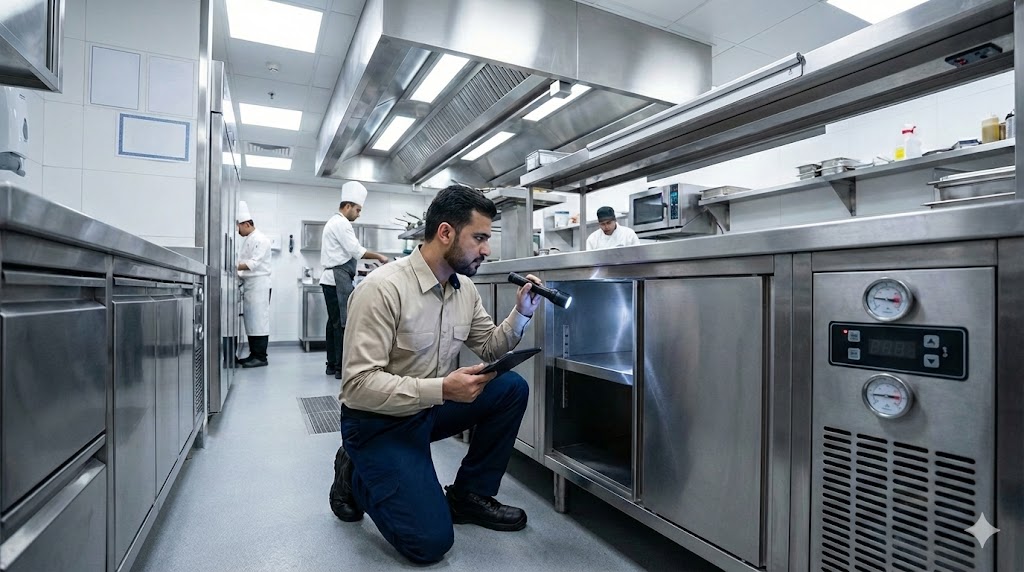
Tell the inspector what the business handles, opening hours, delivery patterns and any recent sightings. Include storage rooms, staff areas, waste routes and external access points rather than showing only the room where a pest was seen.
| Area | Inspection focus | Person likely to own a correction |
|---|---|---|
| Receiving and loading | Open doors, pallet condition and incoming packaging | Operations or receiving supervisor |
| Food preparation | Food protection, residues and inaccessible equipment gaps | Food-safety and cleaning leads |
| Storage | Stock rotation, inspection space and damaged packaging | Store or warehouse manager |
| Waste area | Container condition, collection and spill cleanup | Facilities and waste contractor |
| Building perimeter | Openings, drains and vegetation touching access points | Maintenance or building management |
The pest contractor can identify many defects but may not be contracted to repair them. Name an owner and target date for each recommendation so the programme does not become a list of recurring observations.
Food businesses: protect the process during treatment
Agree how food, utensils, packaging and food-contact surfaces will be protected before application begins. The service plan should explain where treatment is proposed, which products are involved and what preparation, cleaning and re-entry instructions apply. Arrange access outside production where needed rather than improvising around exposed food.
ADAFSA’s grocery licensing and operational guidance describes routine pest monitoring and treatment and keeping visit and finding records at store level. Its older contractor-authority wording should be read alongside ADPHC’s current permit responsibility. For another activity, confirm the relevant requirements instead of assuming the grocery guidance applies unchanged.
Report sightings through the business’s food-safety process. The response to affected stock or food should be determined by the responsible food-safety person using the applicable procedures, not by an informal promise that a quick spray makes everything usable.
Warehouses: separate incoming pressure from resident activity
Record whether damage is found on newly received goods or stock already held on site. Keep photographs, delivery details and the exact storage location so the source can be investigated. Move suspect items through the business’s controlled procedure rather than scattering packaging across other storage areas.
Inspect loading-door seals, service penetrations and cluttered edges where access becomes difficult. Request a monitoring layout that the team can find and protect during normal operations. Devices that disappear behind moving pallets cannot provide a useful history unless the layout is updated.
Ask how contractor access will work around forklifts, secured areas and hazardous stock. Safety arrangements belong in the site plan. A treatment proposal should not require staff to improvise at height or enter restricted areas without appropriate control.
What the service record should contain
Request a report that identifies the date, inspected areas, pest evidence, device findings, treatment locations and products used. It should also state preparation or re-entry instructions, recommendations, unresolved access issues and the next review. A signature confirms the visit occurred; it does not by itself show that the infestation is resolved.
Keep a sighting log between visits, with a location and action taken. Compare the same zones over time rather than adding every type of insect into a single headline number. A finding in a receiving area may need a different response from repeated activity beside a food preparation bench.
Review records with the contractor and the responsible manager. If activity persists, ask what assumption has changed: identification, access, treatment placement, sanitation or a building defect. Repeating the original intervention without investigating the trend is not a complete corrective plan.
Compare proposals by responsibility, not visit count alone
A clear proposal states covered pests, included areas, access arrangements, monitoring, treatment and follow-up terms. Ask what triggers an additional visit, what is excluded and which repairs remain the client’s responsibility. Price can only be compared meaningfully when the scope is comparable.
Do not accept a guarantee that a contract will prevent every inspection issue or protect the business from every regulatory consequence. Pest management is one part of maintaining the premises and the operation. Useful prevention depends on staff, cleaning, maintenance and supplier controls working alongside the contractor.
Read about smart IPM solutions and general pest control when preparing your brief. For provider selection, use the Abu Dhabi pest-control comparison as a starting point for checks, not a replacement for current permit verification.
Frequently asked questions
Who handles pest-control permits in Abu Dhabi?
ADPHC states that it issues and renews permits for public-health pest-control activities. Request current contractor documentation and verify that its scope fits the proposed service.
Does every business need the same visit schedule?
Do not assume a universal interval from a generic online guide. Agree a risk-based programme and verify any requirements that apply to your particular activity.
What should I keep after a service visit?
Keep findings, inspected areas, relevant device records, treatment details and corrective recommendations. The report should also identify access limitations and follow-up actions.
Can treatment take place around exposed food?
Plan food protection and application conditions in advance. Follow the product instructions and the business’s food-safety procedures rather than improvising during production.
Who is responsible for closing building gaps?
The contract should say whether the pest provider, maintenance team or building manager carries out repairs. Give each corrective action an owner and a completion date.
Does a pest-control contract guarantee compliance?
No contract alone establishes compliance with every operational requirement. Check current authorisation, maintain records and address sanitation, stock and building issues through the responsible teams.
Arrange a site-specific inspection
Send your activity type, floor plan and recent findings to GRMC Pest Control. Request a site inspection and a written proposal covering the necessary authorisation, service scope, reporting and corrective responsibilities.