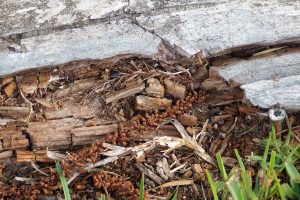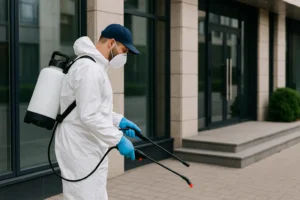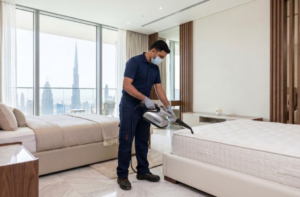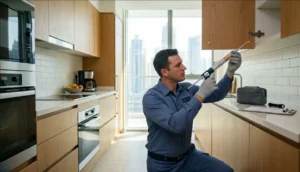
The early signs of pest infestation are almost never the pest itself. In a UAE apartment or villa they are small and easy to walk past: black specks like ground pepper in the corner of a kitchen cabinet, a tan egg case wedged behind the fridge, dark smudges along the bottom of a wall, or a little heap of gritty pellets under a wooden door frame. Cockroaches and rodents do most of their moving at night, so what you usually find first is the evidence they leave behind in daylight.
Finding one of these is a reason to look closer, not proof of a colony. The quickest way to tell the difference is to clean the spot and check it again two or three days later. Fresh droppings or pellets on a surface you cleaned mean something is active there now. Rodent droppings need to be cleaned wet rather than swept, for reasons covered further down.
This page also answers a question a lot of people search for: whether a sticky floor means pests. Usually it does not, and the section below shows the few situations where it can, and how to tell them apart from a spill in about five minutes.
At GRMC Pest Control, a family business founded in Beirut in 1990 and now with offices in Dubai and Abu Dhabi, the part of every job that decides the outcome is identifying what is actually there before anything gets applied. A homeowner who can read the signs gets a faster, better-aimed treatment, and sometimes finds out no treatment is needed at all.
This guide sorts the early signs of pest infestation into the ones that confirm a problem and the ones that only suggest one, then shows where to look in a UAE tower apartment and in a villa. A flat has no basement or attic, and many villas have neither, so the checks below are built around false ceilings, under-sink cabinets, floor drains and boundary walls.
Early signs of pest infestation: which confirm it and which only suggest it
The signs below carry different weight, and sorting what you have found into one of these groups tells you how seriously to take it.
- Confirming signs: live insects or rodents at a hiding place, droppings, egg cases, shed skins, drywood termite pellets and termite mud tubes. Each is physical evidence that something lived or fed at that exact spot.
- Supporting signs: gnaw marks, greasy rub marks along a wall, a persistent smell, scratching in the false ceiling at night, or winged insects gathering at a window. They point towards a pest without identifying it, so they need a confirming sign next to them before anyone should treat.
- Signs that mislead: a floor that is sticky all over, one large cockroach in the bathroom at night, bites with no bugs found, or a few ants on a spill. Each of these has an ordinary explanation more often than a pest one, and each is covered below.
- The test that settles most doubts: clean the area and look again in two or three days. The University of California’s Statewide IPM Program recommends exactly this for drywood termites, cleaning up the pellets around a kickout hole and checking a few days later to see whether new ones have appeared, and the same logic works for droppings of any kind.
Are sticky floors a sign of pest infestation?
Usually not. A floor that feels tacky across a whole room is nearly always a cleaning problem: a sugary drink that was wiped up rather than washed, floor cleaner mixed too strong or never rinsed off, or cooking grease settling on the tiles around the hob. Large-format porcelain and polished marble, both common in UAE homes, show every film of residue under a bare foot.
Pests become a realistic explanation only when the stickiness sits in one particular spot and something else is there with it. There are three situations where that happens, plus one pest that a sticky floor draws in.
A sticky patch under a plant: honeydew
A sticky patch can also start on a plant above the floor. Insects that feed on plant sap excrete a sugary liquid called honeydew. UC IPM’s guidance on scale insects says soft scales “excrete abundant, sticky honeydew, which drips on plants and surfaces underneath and promotes the growth of blackish sooty mold”, and its aphid guidance describes aphids producing large quantities of the same sticky exudate. Its ant guidance adds that on “outdoor and sometimes indoor plants”, ants protect honeydew producers such as aphids, soft scales, whiteflies and mealybugs.
In a UAE home that means the tile under an indoor ficus, the balcony floor beneath a row of potted plants, or a villa patio under a tree. The patch is clear and glossy, it sits directly below foliage, it comes back within days of washing, and it can turn black in spots as sooty mould grows on it. Turn over a few leaves above it and you will usually find the insects on the undersides or clustered along the stems.
This is a plant problem first. Treating the plant, or moving it off the tile, stops the drip, and the house itself rarely needs a pest control visit because of it.
Dark smears in cabinets and corners: cockroaches
Cockroaches do leave marks, but they do not make a floor tacky. UC IPM’s cockroach guidance identifies the places worth monitoring by “accumulations of fecal matter (e.g., dark spots or smears)”, along with cast skins, egg cases and live or dead cockroaches.
So the pattern is local and dark: brown-black streaks along the back edge of the cabinet under the sink, around cabinet hinges, or at the joint between the skirting and the floor behind the fridge. If a dark, greasy mark in one of those places sits next to pepper-like specks or a papery shed skin, treat it as a cockroach sign and read the droppings section below.
Greasy marks along a wall: rodents
Rats leave a different kind of residue. UC IPM describes “smudge marks caused by the rats rubbing their fur against beams, rafters, pipes, and walls”. In a UAE home they run along the base of a wall, around a pipe where it enters a cabinet, or across the edge of an opening in a gypsum false ceiling, and they follow the same route night after night. They feel greasy rather than sticky, they are dark grey or black, and they never appear as a tacky patch in the middle of a room.
Ants on a sticky spot: the stickiness came first
Ants are the one pest a sticky floor reliably brings in. UC IPM notes that indoors, “household ants feed on sugar, syrup, honey, fruit juice, fats, and meat”.
The same guidance says to “thoroughly clean up grease and spills”, explains that wiping a trail with soapy water removes the scent trail the ants follow, and states that “indoor sprays aren’t usually necessary”. If ants keep arriving after the floor is properly clean, follow the trail back to the point where it enters the room. That entry point is the part worth dealing with.
How to tell in five minutes
- Where it is: across the whole floor points to cleaning residue; directly under a plant points to honeydew; at a cabinet edge, a hinge or behind an appliance points to cockroaches; along the base of a wall or around a pipe points to rodents.
- What colour it is: clear and glossy means honeydew, a sugary spill or detergent film. Dark brown or black with a greasy feel comes from an animal.
- What is above it: a plant, a tree, a shelf of food, or nothing at all.
- Whether it comes back: wash the area with hot water and a little detergent, rinse it with clean water, and check again in two days. Detergent film does not return after a proper rinse. Honeydew and cockroach smears do.
- What is next to it: specks, egg cases, shed skins or gnawed packaging turn a sticky patch into evidence. Without one of them, treat the patch as a cleaning job and recheck it after washing.
If you arrived here from a food safety course, the question that circulates on homework-help sites asks which of four options is not a sign of a possible pest infestation: feathers, dead insects, torn packaging or sticky floors. We could not confirm the official answer key, so what follows is GRMC’s reading, and your own course materials have the final say. Of those four, sticky floors is the only one that is not evidence of pests by itself. Feathers show birds are getting in, dead insects are the pest, and torn or gnawed packaging is feeding damage. In a food business a sticky floor still matters, because a spill that stays down feeds whatever finds it, so it belongs on the cleaning schedule straight away.
Droppings: the sign that tells you the most
Droppings are the most informative early sign, because their size, shape and position usually identify the animal before you have seen it.
Cockroach droppings and egg cases
The small cockroach found in kitchen cabinets is often the German cockroach (Blattella germanica). UC IPM describes the adult as half an inch long, light brown, with two dark stripes on the plate behind the head, and says it favours “warm (70° to 75°F), humid areas that are close to food, water, and dark areas for harborage”. That is roughly 21 to 24 degrees Celsius, close to the temperature many air-conditioned UAE kitchens are kept at all year.
Its droppings are the black specks or smears described above, collected where the insects rest: the hinge side of cabinet doors, the back corners of the cabinet under the sink, and the warm motor compartments of the fridge and dishwasher. The egg case is the other thing to look for. Penn State Extension says each capsule “contains up to 48 eggs (usually 30 to 48)”, carried by the female until hatching time, when she deposits it into crevices and other sheltered spots. An empty case in a crack behind the fridge has already hatched.
The large reddish-brown cockroach that turns up in a bathroom at night is a different case. Penn State Extension puts the American cockroach at “approximately 1½ inches long and reddish-brown”, typically found in damp places including floor drains, pipe chases and sewers. One of those in a guest bathroom usually means a drain route needs closing: run water into floor drains that are rarely used so the trap stays full, and fit covers where they are missing.
Droppings are also a health question, beyond the nuisance. The US Environmental Protection Agency states that “droppings or body parts of cockroaches and other pests can trigger asthma”, which is the real reason to act on a few specks in a kitchen cabinet. Our guide to getting rid of small cockroaches in the kitchen covers what to do once you have confirmed them, including why sprays tend to make kitchen infestations harder to clear.
Rodent droppings, and how not to clean them
UC IPM lists rat droppings “near food preparation areas, storage areas, or around pet food containers” among the signs of rats. For mice, its guidance says to “look for droppings, fresh gnaw marks, and tracks, which indicate areas where mice are active”. Mouse droppings are noticeably smaller than rat droppings, and both tend to turn up along walls and inside cupboards.
How you clean them matters more than most people expect. The US Centers for Disease Control and Prevention says “Don’t vacuum or sweep rodent urine, droppings, or nesting materials”, because doing so can put tiny droplets carrying viruses into the air. The CDC’s method is to open doors and windows for 30 minutes before starting, wear rubber or plastic gloves, and spray the droppings until very wet with a bleach solution of 1 part bleach to 9 parts water, or a household disinfectant, then leave it to soak for 5 minutes before wiping up. Mix the bleach with plain water only, never with another cleaner or detergent.
Then check the same spot two or three days later. New droppings on a surface you cleaned mean the activity is current, and that is the point to arrange a rodent control inspection, which should start with finding how the animal is getting in.
Bed bug spotting
Bed bugs leave droppings too, and they are easy to mistake for dirt. The University of Kentucky’s entomology extension describes “dark spotting and staining, which is the dried excrement of the bugs”, often along mattress seams, as well as rusty or reddish smears on sheets from engorged bugs that were crushed, and tan-coloured skins shed by the young.
Kentucky is also clear that bites do not settle the question: “Confirmation requires finding the bugs and/or their signs”. People react to bites very differently, so the next step after a bite pattern is to check the bed itself. Our bed bug treatment guide for Dubai lists the inspection points on a bed in the order to check them.
Drywood termite pellets
Fine, gritty pellets collecting in a small heap on a windowsill, a floor or the top of a skirting board, below wooden furniture, a door frame or a timber ceiling, are a very specific sign. UC IPM says drywood termite fecal pellets “have six hexagonal sides and are diagnostic for drywood termites”, pushed out of the wood through kickout holes it describes as less than 2 mm in diameter. A magnifying glass or a phone camera zoomed in is enough to see the ridged shape. Sweep the heap away with a dry cloth, check the spot again a few days later, and treat a fresh heap as an active infestation.
Marks, damage and winged insects
These signs rarely identify the pest on their own, but they show where it has been and how it is getting around.
Gnaw marks, nests and the gaps rodents use
Chewed corners on food packaging in the pantry, gnawed cable sheathing inside a kitchen cabinet and shredded nesting material behind stored boxes are all rodent signs. UC IPM describes mouse nests as “made of finely shredded paper or other fibrous material”, found behind boxes, in drawers and in garages.
The gaps involved are small. UC IPM notes that house mice “can squeeze under gaps ¼ inch tall, and through openings 3/8 inch wide”, which is about 6 mm and 10 mm. In a UAE apartment the gaps that matter are where pipes and cables pass through the back of kitchen cabinets, the space under a door into a service shaft, and holes cut through walls for air conditioning pipework.
Mud tubes and wood that gives under a screwdriver
Subterranean termites build earth tunnels to travel between the soil and the wood they feed on. UC IPM says “shelter tubes (sometimes called mud tubes) are the most commonly seen evidence of a subterranean termite infestation”. It also describes darkening or blistering of wood, and wood that is “thin at the surface and easily punctured with a knife or screwdriver”. In a villa, check ground floor walls behind furniture, door frames and skirting where they meet the slab, built-in wardrobes on exterior walls, and wooden pergolas and garden structures.
In Dubai, termite control is a separate specialist listing. Dubai Municipality publishes its termite control companies apart from its general list of approved pest control companies, so whoever you call about termites should appear on that termite list specifically. Our guide to checking Dubai Municipality approved pest control shows how to find the right list and search it in a couple of minutes.
Flying ants or termite swarmers at a window
Termite swarmers and flying ants both gather at windows and lights, and UC IPM warns that winged termites can easily be confused with winged ants, pointing to the antennae, the wings and the waist as the way to tell them apart.
Termites have straight antennae, a thick waist with no pinch, and two pairs of wings of about equal length that break off easily, so a scatter of discarded wings on a sill is a clue in itself. UC IPM lists shed wings among the signs inspectors look for with drywood termites. Ants have elbowed antennae, a narrow pinched waist, and front wings noticeably longer than the back pair.
Cockroaches in daylight
Seeing German cockroaches in daylight is a sign in its own right. Penn State Extension notes that German cockroaches are mostly active at night, and that they “may be seen during the daytime, particularly if a heavy population is present or if there is some other stress, such as a lack of food or water or an application of pesticides”. If you are seeing them in daylight and nobody has sprayed recently, the population hiding in the cabinets is probably larger than the few you have seen.
Smells and sounds come late
Smell is the sign people mention most and the least useful at the early stage. Penn State Extension says German cockroach secretions produce a characteristic odour in the area of an infestation “when cockroach populations are high”. Kentucky says the often-mentioned bed bug odour “is seldom apparent except in extreme infestations and should not be relied upon for detection”. UC IPM associates “a musky odor” with mice. By the time a room smells of a pest, the early stage has usually passed, so use a smell as the prompt to search nearby for droppings.
Sound is more useful for rodents. UC IPM lists “noises coming from the attic or drop ceilings” as a sign of rats, and says roof rats indoors favour “attic spaces, walls, false ceilings, and cabinets”. The UAE version is scratching or running in the gypsum false ceiling at night, often above the kitchen or around the air conditioning ducts. Droppings on top of the ceiling tiles, visible through an access hatch or around a light fitting, confirm it.
Where to look in a UAE apartment
Most signs-of-pests advice is written for houses with basements, attics and gutters. A tower apartment has none of those, so these are the places where the same pests actually turn up in a flat in Dubai or Abu Dhabi.
- Under the kitchen sink: where the pipes pass through the back panel of the cabinet. The pipe gap brings moisture and a route into the wall, which makes it the first place to check for cockroach specks and rodent droppings.
- Cabinet hinges and the top corners of wall cabinets: German cockroaches rest in tight, warm gaps close to food, and the hinge side of a door collects their droppings.
- Behind and under the fridge and dishwasher: the motor compartments stay warm, and crumbs and spills collect under appliances where the mop never reaches.
- Floor drains in bathrooms and the laundry area: a drain in a guest bathroom that is rarely used can dry out, which leaves an open route up from the building’s drainage stack.
- The air conditioning cupboard or the hatch to the fan coil unit: in district-cooled buildings the unit has a condensate tray and drain, and the damp around it suits cockroaches.
- The false ceiling: scratching at night, droppings around access hatches and light fittings, and rub marks at the edge of any opening.
- The balcony: plant pots for honeydew and ant trails, and feathers and droppings on the ledge if birds are roosting.
- The chute room and the corridor: signs here are the building’s problem as much as yours. Tell building management in writing, because the building may already have a pest control contract for the common areas.
In a tower, drainage stacks, service risers and the gaps around pipework connect units that never see each other, so a sign that keeps returning after a careful clean can be coming from next door. Our home pest prevention guide covers how to close the routes in once you know what you are dealing with.
Where to look in a villa
A villa adds a garden, a boundary wall and a lot more timber, and each brings its own signs.
- The base of the boundary wall and around the bin store: UC IPM says Norway rats dig burrows along building foundations and beneath trash piles, and lists burrows “beneath garbage cans and compost piles or among garden plants” as a sign. Look for holes with fresh soil kicked out around them.
- Dense planting, hedges and trees: UC IPM says roof rats usually nest above ground “in shrubs, trees, or dense vegetation” and can be seen “traveling along utility lines or on fence tops at dusk”. The top of the boundary wall at dusk is worth watching for a few evenings.
- Ground floor door frames, skirting and built-in joinery: mud tubes and blistered wood where timber meets the slab or an exterior wall.
- Wooden furniture, doors and window frames anywhere in the house: small heaps of six-sided pellets below them, including heavy carved pieces in the majlis that rarely get moved.
- Irrigation points, the pool pump room and the outdoor kitchen: constant moisture and food waste draw cockroaches and ants, and a pump room is warm and rarely visited.
- The kitchen, store room and maid’s room: the same checks as an apartment kitchen, plus bulk dry food in the store room, where gnawed sacks and droppings on shelves show up first.
What to do in the first 48 hours
The aim in the first two days is to find out what you have and whether it is active, without making the later treatment harder.
- Photograph before you clean: a clear photo with a coin beside the droppings or pellets for scale lets a technician identify most pests before arriving, and gives you a record if you rent.
- Clean, then recheck: rodent droppings wet, using the CDC method above; everything else with a damp cloth. Look again at the same spots in two or three days.
- Put out insect monitors: UC IPM calls sticky traps or glue boards the best way to detect and monitor cockroach populations, and notes that cockroaches are often caught within the first 24 hours. Place them inside cabinets and behind appliances, out of reach of children and pets.
- Hold off on retail sprays: a spray chosen before you know the species can push insects deeper into cabinets and wall gaps, which makes the professional treatment slower. UC IPM’s ant guidance makes the same point for ants, saying indoor sprays are not usually necessary.
- Take away the food: the EPA’s own advice is to “store food in airtight containers” and to “clean dishes, crumbs and spills right away”, which starves a small population while you work out what it is.
- If you rent, tell the landlord in writing: send the photos and the dates. Who pays for treatment usually comes down to the maintenance clause in your tenancy contract, and a written record settles most arguments before they start.
When to call a professional, and what to check first
Call when a confirming sign comes back after you have cleaned it, when you find signs in more than one room, or when the signs point to rodents or termites, which are not realistic do-it-yourself jobs. Before anyone treats anything, check who they are.
In Dubai, pest control companies are cleared by Dubai Municipality’s Public Health Pest Control Section through a No Objection Certificate, and the Municipality publishes the list of approved companies. There is no public licence number to quote or look up. GRMC is on that list, at entry 135 of the general pest control list in the August 2026 edition, in Group C, under the registered name G R M C FOR PUBLIC HEALTH PESTS CONTROL SERVICES CO. L.L.C. GRMC is not on the Municipality’s separate termite, fumigation or bird control lists, so for termite work in Dubai choose a company from the termite list. The groups are headcount bands (Group C covers companies with 1 to 10 qualified staff, according to the list’s own notes), so the letter describes the size of a team and carries no quality grade.
Abu Dhabi has a different regulator. The Abu Dhabi Public Health Centre says on its own site that it “has now taken on the responsibility of overseeing and regulating pest control services in Abu Dhabi” and “will issue and renew work permits for all public health pest control activities”. ADPHC publishes no public register, so for an Abu Dhabi property ask the company for its permit documentation directly. A Dubai Municipality approval is a Dubai credential and does not carry across the emirate line.
Our inspection is free, and every treatment we carry out comes with our 100% Pest-Free Or Money Back offer: if the pest is still there after the treatment and the follow-up visit, you get your money back. Contact GRMC Pest Control to book an inspection in Dubai or Abu Dhabi. Send the photos when you book, tell us whether it is an apartment or a villa, and arrange the gate pass or building access for the day so the technician is not held at security.
Frequently asked questions
What are the early signs of pest infestation in a home?
The earliest reliable signs are droppings, egg cases, shed skins and, for drywood termites, small six-sided pellets, and they are usually found before the pest itself because cockroaches and rodents are mostly active at night. Greasy rub marks along walls, gnaw marks, scratching in a false ceiling and a persistent smell also point to pests but do not identify them. Cleaning the spot and checking again two or three days later shows whether the activity is current.
Are sticky floors a sign of pest infestation?
Usually not. A floor that is sticky across a whole room is almost always a spilled drink, floor cleaner residue or cooking grease. Stickiness points to pests only in specific spots: honeydew dripping from sap-feeding insects such as scales and aphids on a plant above it, which UC IPM describes as sticky and prone to blackish sooty mould, dark smears where cockroaches rest in cabinets, or greasy rub marks where rats run along walls. If a patch returns after a proper wash and rinse, check what is above it and what is next to it.
What do cockroach droppings look like?
German cockroach droppings look like ground black pepper and collect where the insects rest, such as cabinet hinges, the back of the cabinet under the sink and behind the fridge. UC IPM describes accumulations of cockroach fecal matter as dark spots or smears, usually found alongside shed skins and egg cases. The egg case is a small, light brown capsule, which Penn State Extension says contains up to 48 eggs.
How can I tell if a pest infestation is active or old?
Clean the droppings, pellets or smears away completely, then check the same spot two or three days later. New evidence on a cleaned surface means the pests are active now, while a spot that stays clean for several days points to older evidence. UC IPM recommends this test for drywood termite pellets, and a sticky insect monitor placed in a kitchen cabinet does the same job for cockroaches.
Is it safe to sweep or vacuum rodent droppings?
No. The US Centers for Disease Control and Prevention advises against sweeping or vacuuming rodent urine, droppings or nesting material, because it can put tiny droplets carrying viruses into the air. The CDC recommends ventilating the room for 30 minutes, wearing rubber or plastic gloves, and spraying the droppings until very wet with a disinfectant or a solution of 1 part bleach to 9 parts water, left to soak for 5 minutes before wiping up. Mix the bleach with plain water only, never with another cleaner.
How do I tell flying termites from flying ants?
Look at the antennae, the waist and the wings, which UC IPM names as the features that separate them. Termites have straight antennae, a thick waist and two pairs of wings of about equal length that snap off easily, so discarded wings on a windowsill are a clue. Flying ants have elbowed antennae, a narrow pinched waist and front wings longer than the back ones.
Who regulates pest control companies in Dubai and Abu Dhabi?
In Dubai, the Municipality’s Public Health Pest Control Section clears pest control companies with a No Objection Certificate and publishes a list of approved companies, with termite control, fumigation and bird control listed separately from general pest control. In Abu Dhabi, the Abu Dhabi Public Health Centre states on its own site that it issues and renews work permits for all public health pest control activities. Abu Dhabi publishes no public register, so ask any company there for its permit documentation.
Does GRMC charge for a pest inspection?
No, GRMC’s inspection is free in Dubai and Abu Dhabi. Every treatment GRMC carries out comes with its 100% Pest-Free Or Money Back offer: if the pest is still there after the treatment and the follow-up visit, the client gets their money back. Photos of what you have found, sent when you book, help the technician identify the pest before arriving.
Sources on this page were checked on 21 September 2026. Where a figure appears, the organisation it comes from is named in the same sentence, and the linked extension and government pages are the ones we read.